
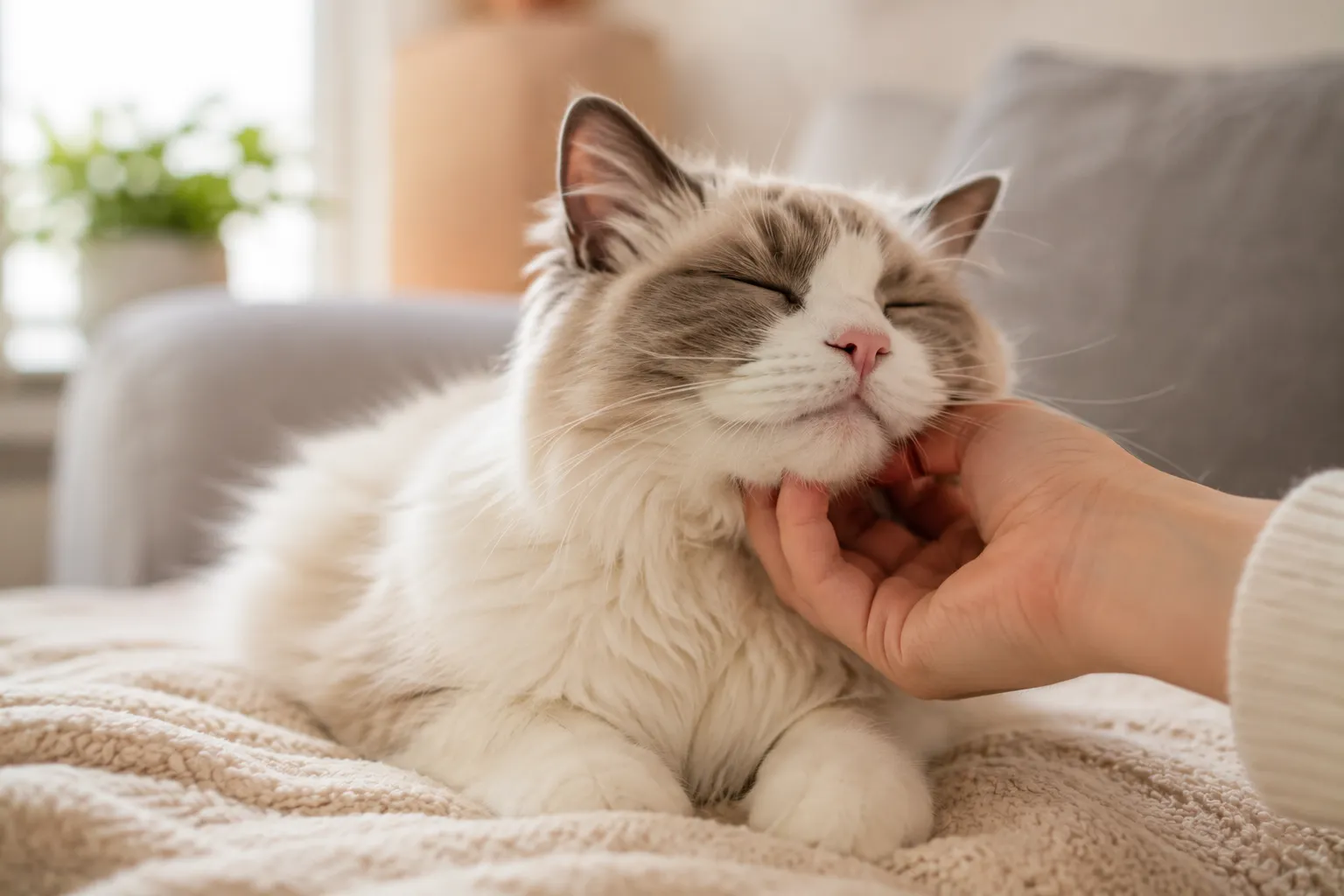
There is a reason sleep apps use purring as a white noise option. That low, rhythmic rumble is basically nature's ASMR — except it is warm, fuzzy, and occasionally drools on your shirt. But if you think your cat only purrs because they are happy, you are missing about 80% of the story.
Purring is one of the most fascinating and misunderstood behaviors in the animal kingdom. It is a complex vocalization that serves as communication, therapy, self-medication, and emotional expression all at once. Scientists have spent decades trying to decode it, and while we do not know every single secret, the research is wild.
So grab your cat — if they are in the mood, obviously, we do not force affection here — and let us dive into the real science behind why cats purr.
1. What Is A Purr, Actually? The Anatomy Of A Rumble
First, let us talk about how the sausage gets made. Or rather, how the motorboat gets motorized.
A purr is produced in the larynx — the voice box — where a cat's vocal folds live. As the cat breathes, air passes over these folds, causing them to vibrate. But here is the weird part: unlike a meow, which only happens on the exhale, a true purr happens during both inhalation and exhalation. That is why it sounds continuous, like a little engine that never quite turns off.
For decades, scientists believed purring required active muscle contractions controlled by the brain — basically a neural metronome telling the larynx when to twitch. But a groundbreaking 2023 study published in Current Biology flipped that idea on its head. Researchers took the larynges of deceased cats, pumped warm air through them, and the larynges purred on their own — no brain, no muscles, no neural input required.
What they discovered were specialized connective tissue masses embedded in the vocal folds — little fibrous blobs that allow the folds to vibrate at unusually low frequencies. Think of it like the vocal equivalent of a bass guitar string: thicker, heavier material produces deeper tones without needing to be longer. This "vocal fry" mechanism lets a 10-pound house cat generate the same low-end frequencies as animals many times their size.
The hyoid bone — a horseshoe-shaped structure near the tongue — also plays a role. In domestic cats, the hyoid is fully bony, which resonates those low vibrations and allows the signature two-way purr. In big cats like lions and tigers, the hyoid contains cartilage, which means they cannot produce a true purr. More on that later.
2. The Purr Frequency: Nature's Healing Playlist
Here is where it gets legitimately mind-blowing. A domestic cat purrs at a frequency between 25 and 150 Hertz. That is not random. That specific range overlaps almost exactly with the frequencies used in therapeutic ultrasound and vibration therapy for humans.
Research has shown that low-frequency vibrations in the 25–50 Hz range promote bone density and fracture healing. Frequencies around 100 Hz are used to reduce pain, swelling, and muscle strain. And the full 20–150 Hz range has been associated with improved joint mobility, tendon repair, and even easier breathing.
Dr. Leslie Lyons at the University of Missouri noted that these frequencies correspond to the best-documented healing frequencies in medical literature. Cats spend roughly 70% of their lives resting and sleeping. From an evolutionary perspective, purring may be a low-energy way to keep bones strong and muscles toned during all that downtime — an internal workout machine that runs on autopilot.
Now, before you cancel your health insurance and just hug your cat harder: there is no large-scale scientific evidence that a cat's purr literally heals human bones or wounds. The studies on feline purring as a healing mechanism are promising but limited, mostly involving small samples or anecdotal observation. What we do know for certain is that petting a purring cat lowers human cortisol and blood pressure, which definitely supports cardiovascular health.
3. Why Do Cats Purr? It Is Not Just Because They Are Happy
If purring were simply a "happiness noise," veterinarians would not need stethoscopes. The truth is that cats purr in a wide range of emotional and physical states — some positive, some deeply uncomfortable.
Contentment And Bonding
Yes, cats absolutely purr when they are relaxed, warm, and loved. A cat sprawled in a sunbeam, kneading a soft blanket, and purring with half-closed eyes is basically broadcasting bliss. Mother cats purr while nursing, and kittens begin purring as early as two days old — before their eyes and ears even work. The vibrations help guide newborns to the milk bar and strengthen the mother-kitten bond.
Adult cats also purr during friendly social interactions. It is short-range animal communication — a way of saying "I am safe, you are safe, we are cool." When your cat purrs while curled against you, they are not just enjoying the moment. They are actively reinforcing your relationship.
Communication And The Solicitation Purr
Cats are manipulative geniuses, and we mean that with love. Research from the University of Sussex found that many cats embed a high-frequency cry-like sound within their purr when they want something — usually food. This "solicitation purr" mimics the frequency of a human infant's distress cry, which makes it nearly impossible for us to ignore. It is not an accident. It is evolutionarily optimized begging.
So if your cat purrs at you at 6 a.m. while standing next to their empty food bowl, they are not being affectionate. They are running a psychological operation, and you are the target.
Self-Soothing And Stress Relief
Here is the part that surprises people: cats purr when they are scared, stressed, or in pain. A cat at the vet's office may purr while being examined. A cat in a carrier may purr during a car ride from hell. Some cats even purr during euthanasia.
This is not denial or delusion. It is self-soothing. The act of purring triggers the release of endorphins — the body's natural painkillers and mood stabilizers. It is like a built-in coping mechanism that helps them regulate their nervous system when things get overwhelming. Think of it as a cat version of deep breathing or squeezing a stress ball.
Behaviorists call this a displacement behavior — a repetitive action that reduces internal tension. Just like some people clean obsessively when anxious, some cats purr when frightened. Context and body language are everything. A purring cat with relaxed ears and half-shut eyes is happy. A purring cat with flattened ears, a tucked tail, and rigid muscles is coping.
Healing And Pain Management
Because the purr frequency range overlaps with therapeutic vibration frequencies, researchers have long theorized that cats use purring as a form of self-healing. Cats are notorious for hiding illness and injury — a survival instinct from their wild ancestors. Purring may help them manage pain, reduce inflammation, and maintain bone density during recovery from illness or trauma.
Anecdotal evidence shows that injured cats sometimes have companion cats lie beside them and purr. Whether this is intentional healing or just empathetic companionship, we do not know. But the idea of cats as furry little physical therapists is compelling.
4. Why Big Cats Do Not Purr (And Why House Cats Cannot Roar)
This is one of the coolest trivia facts in all of zoology, and it comes down to one tiny anatomical difference.
Domestic cats, cheetahs, pumas, ocelots, servals, and lynxes all have a fully ossified — completely bony — hyoid apparatus. That rigid structure resonates the low vibrations of a purr and allows the sound to form on both inhale and exhale.
Lions, tigers, leopards, and jaguars have a hyoid apparatus made of bone and cartilage. The flexible cartilage does not resonate the same way, so they cannot produce a true purr. Instead, they roar — a completely different vocalization powered by a specialized larynx and strong throat muscles.
So the animal kingdom is divided into two camps: the purrers and the roarers. Your house cat is firmly in camp purr, which is probably for the best. A roaring Maine Coon would be absolutely terrifying at 5 a.m.
5. Do All Cats Purr?
Nope. While most domestic cats are physically capable of purring, some simply do not. It might be due to subtle anatomical differences in the larynx or vocal folds. Some cats purr so quietly you can only feel it by pressing your hand against their throat. Others are basically motorboats you can hear from the next room.
If your cat has always been silent, that is probably just their personality or physiology. But if a previously vocal purrer suddenly stops, pay attention. A sudden change in purring habits can signal stress, illness, pain, or issues with the larynx, throat, or respiratory system. When in doubt, call your vet.
6. How To Tell What A Purr Means (Context Is Everything)
Purring is not a monolith. It is a multipurpose tool, and the only way to know what it means is to look at the full picture — body language, environment, and behavior.
Happy purr: Relaxed posture, half-closed eyes, slow blinking, kneading, tail resting calmly. Usually happens during petting, napping, or greeting.
Hungry purr: Persistent, directed at you, often combined with rubbing against your legs or leading you toward the kitchen. May have a slightly higher-pitched, urgent edge.
Stressed purr: Rigid body, flattened ears, tucked tail, dilated pupils, possibly hiding or crouching. The purr is a coping mechanism, not a celebration. Give them space.
Pain or illness purr: May occur with lethargy, loss of appetite, or unusual hiding. The cat may purr while resting in odd positions or avoiding movement. Trust your gut. If the purr feels "off" because the behavior around it is off, call the vet.
Frequently Asked Questions
Why do cats purr when you pet them?
Because they like it — usually. Petting triggers the release of oxytocin in both you and the cat, creating a feedback loop of warm fuzzy feelings. The purr is their way of saying "yes, more of that, please." If they purr but then suddenly bite you, that is "petting-induced aggression," and it means they got overstimulated. Watch for tail twitching and ear rotation as warning signs.
Why do cats purr and knead?
Kneading is a leftover behavior from kittenhood. Nursing kittens knead their mother's belly to stimulate milk flow, and they often purr while doing it. Adult cats knead soft surfaces when they are content because it reminds them of that early comfort. The purr-plus-knead combo is basically nostalgia in action.
Can cats purr when they are dying?
Yes, and it is heartbreaking. Some cats purr in their final moments, likely as a self-soothing behavior. The endorphin release and familiar vibration may provide comfort during a stressful transition. It does not mean they are happy. It means they are coping the only way they know how.
Can a cat's purr heal you?
Not in a "lay on a broken leg and call it physical therapy" kind of way. But the act of petting a purring cat demonstrably lowers your blood pressure, reduces stress hormones, and promotes relaxation. Those benefits are real and medically supported. Just do not toss your antibiotics because your cat sat on your lap.
Why is my cat's purr so loud?
Some cats are just built different. Larger cats or those with more relaxed laryngeal muscles may produce louder purrs. Breeds like Maine Coons and Bengals are sometimes known for motorboat-level volume. If the purr suddenly changes pitch or becomes raspy, though, check for upper respiratory issues.
My cat stopped purring. Is something wrong?
Maybe. Sudden silence from a previously vocal cat can indicate stress, illness, laryngeal inflammation, or discomfort. If the change is accompanied by other symptoms — lethargy, appetite loss, coughing, or behavioral shifts — schedule a vet visit. If your cat has simply never been a purrer, they are probably fine. Just emotionally constipated.
Related CatCutieSweet Guides
The Bottom Line
Purring is not a simple happiness meter. It is a sophisticated biological tool that cats use to communicate, bond, self-soothe, and possibly even heal themselves. That little motor running in your lap is the product of millions of years of evolution, specialized vocal anatomy, and some genuinely wild neuroscience.
So the next time your cat purrs while you are petting them, appreciate the complexity. They might be saying "I love you." They might be saying "feed me." They might be saying "my arthritis feels better when I do this." Or they might be saying all three at once, because cats are efficient like that.
Whatever the reason, the purr remains one of the most soothing, mysterious, and scientifically fascinating sounds in the animal kingdom. And honestly? We are just lucky they let us listen.