
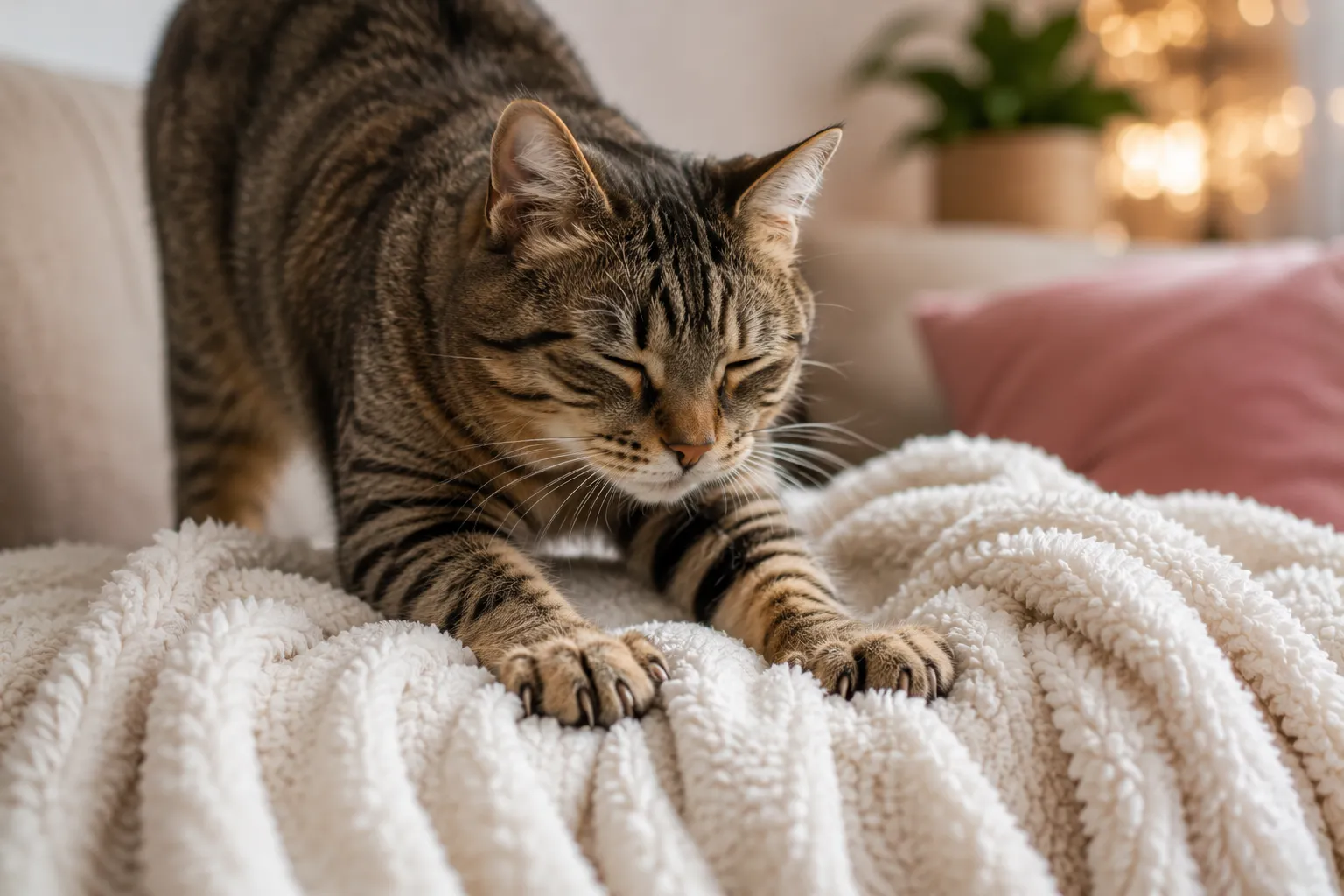
You are sitting on the couch, half-watching a show, when your cat hops into your lap, finds a soft spot on your thigh, and starts rhythmically pushing their paws in and out. Left paw, right paw, left paw, right paw. They look blissed out, maybe drooling a little, definitely ignoring your existence beyond the fact that you are warm and squishy. You, meanwhile, are trying not to scream because their claws are digging into your leg through your jeans.
Congratulations. You are being made into biscuits.
Kneading, often referred to as “making biscuits,” is one of the behaviors domestic cats are best known for. It’s an instinctual behavior where the cat alternates pushing his paws into a soft surface, such as a blanket, several times in a row, similar to how a person would knead dough. PetMD
Cat kneading is one of those behaviors that looks adorable, feels weird, and leaves you wondering: why do they do this? Is it affection? Is it a throwback to kittenhood? Are they secretly trying to turn you into bread? The answer is yes, yes, and probably not — but the full story is way more interesting than you think.
1. What Is Kneading, Exactly?
Kneading is a rhythmic motion where a cat pushes their front paws alternately into a soft surface — your lap, a blanket, a pillow, your stomach at 6 a.m. — often extending and retracting their claws with each press. Some cats knead with all four paws. Some purr, drool, or suckle on the fabric while doing it. Some keep it strictly business with just the paws.
According to the Cat Behavior Clinic, kneading is a multi-faceted behavior that bridges the gap between wild instincts and domestic comfort. It is not random. It is deeply encoded feline behavior that serves several biological and emotional purposes at once.
2. The Kitten Connection: Nursing Instincts That Last Forever
The most widely accepted explanation starts in kittenhood. Newborn kittens knead their mother's belly while nursing to stimulate milk flow from the mammary glands. The rhythmic pressure triggers oxytocin release in the mother, which promotes milk production and ensures the kittens get fed. Goodheart Veterinary
But kneading is not just about milk. It is about bonding and security. The combination of warmth, nourishment, and the mother's calming pheromones creates an intense sense of safety. For the kitten, kneading equals comfort, survival, and love — all wrapped into one repetitive motion.
Fast-forward to adulthood, and the behavior persists even though there is no milk to be had. Your cat kneads your lap or a soft blanket because it reminds them of that early comfort. It is nostalgia in action. When your cat kneads and purrs simultaneously, they are essentially re-creating the safest, happiest moment of their early life. And if you happen to be the surface they are kneading? That means they trust you enough to regress to baby mode. It is weirdly flattering.
3. Territory Marking: You Are Being Claimed
Here is something most people do not realize: cats have scent glands in their paw pads. Every time they knead, they are depositing pheromones onto the surface. Those invisible chemical markers say "mine" to any other cat who might come sniffing around. Sheba
So when your cat kneads your leg, your bed, or your favorite sweater, they are not just getting comfy. They are marking you as part of their territory. In multi-cat households, dominant cats may knead more frequently or in more prominent locations to assert their status. It is feline graffiti, but instead of spray paint, they use their feet and your furniture.
This territorial aspect is also why cats often knead before settling down to sleep. Wild felines kneaded grasses and leaves to flatten bedding and create a safe nest. Domestic cats do the same on blankets, cat beds, and your stomach. They are literally making their bed before they lie in it. Blue Buffalo
4. Stress Relief: Kneading As Self-Soothing
Kneading is not always about happiness. Sometimes it is about coping. The rhythmic motion triggers the release of endorphins — the brain's natural painkillers and mood elevators. This is the same chemical cascade that helps humans feel better during repetitive activities like knitting, running, or squeezing a stress ball. PetMD
When cats are anxious, overstimulated, or in an unfamiliar environment, they may knead more frequently as a way to self-regulate. Think of it as a displacement behavior — a repetitive action that reduces internal tension. Some cats knead compulsively when stressed, which can look excessive but serves a genuine psychological purpose.
If your cat suddenly starts kneading way more than usual, pay attention to context. Are there new pets? A move? Loud construction? Changes in routine? Excessive kneading can signal underlying anxiety or even physical discomfort like arthritis or soreness. The kneading stretches their muscles and relieves tension, much like a human stretching after waking up. PetMD
5. The Attention Grab: Kneading To Say "Hey, Look At Me"
Some cats are not subtle about their needs. If your cat kneads you while staring directly into your soul, they might be requesting dinner, playtime, or chin scratches. The knead-plus-purr combo is a powerful attention-getting tool because humans find it nearly impossible to ignore. Blue Buffalo
In multi-cat homes, kneading can also establish social hierarchy. Dominant cats may knead in shared spaces to assert ownership, while subordinate cats might knead on their humans to reinforce their bond and secure their place in the social structure. It is feline politics, played out on your lap.
6. Hormones And Heat: When Kneading Gets Weird
Unspayed female cats sometimes knead more frequently when they are in estrus — commonly called "heat." The behavior is tied to nesting instincts and hormonal fluctuations. A cat in heat may become more affectionate, vocal, and physically active, with kneading as one outlet for that restless energy. Sheba
Spaying usually levels out these hormonal swings and reduces heat-related kneading. If your intact female suddenly becomes a biscuit factory overnight, her ovaries might be the reason.
7. Should You Worry About Kneading?
Generally, no. Kneading is a completely normal, healthy behavior that most cats engage in throughout their lives. However, there are times when it warrants a closer look.
Sudden changes in frequency: If your previously casual kneader becomes obsessive, or if a non-kneader suddenly starts, look for stressors or medical issues. Increased kneading can indicate anxiety, pain, or compulsive behavior disorders. PetMD
Excessive drooling or suckling: Some cats suckle on blankets or clothing while kneading, a behavior called wool-sucking that can become compulsive. It is more common in cats weaned too early but can develop in any cat. If it becomes destructive or obsessive, consult a veterinary behaviorist.
Claw damage: If your cat's kneading is shredding your clothes or drawing blood, keep their nails trimmed short. Place a thick blanket or dedicated cat bed on your lap to create a barrier. Never punish kneading — it is instinctive and punishment will only create fear and anxiety. PetMD
Never declaw. Declawing is not nail trimming — it is amputation of the last bone of each toe. It causes chronic pain, lameness, and behavioral problems. If kneading claws are an issue, trim regularly, use nail caps, or provide alternative surfaces. PetMD
8. How To Manage Kneading Without Losing Your Mind (Or Your Skin)
You do not have to become a human pincushion to bond with your cat. Here are practical ways to redirect kneading behavior without suppressing it:
- Provide dedicated kneading surfaces: Thick, soft blankets or cat beds placed in your cat's favorite spots give them an appropriate outlet. Reward them with treats when they use these surfaces.
- Trim nails regularly: Short claws do less damage. Make nail trims a positive experience with treats and patience.
- Use a barrier: If your cat kneads on you, place a folded blanket on your lap before they settle in. You get protection; they get softness. Win-win.
- Redirect gently: If kneading becomes too intense, calmly lift your cat and place them on their designated blanket. Do not yell or push — just redirect.
- Address underlying stress: If kneading is anxiety-driven, add environmental enrichment (cat trees, puzzle feeders, window perches) and consider synthetic pheromone diffusers like Feliway to reduce tension.
Frequently Asked Questions
Should I pet my cat while they are kneading?
Some cats love it. Others will give you the "I was enjoying that until you touched me" look. Watch their body language. If they are relaxed, purring, and leaning into your hand, pet away. If their ears rotate back or they pause mid-knead, stop. Let them enjoy their biscuit-making in peace.
Why does my cat knead me but not my partner?
Cats bond selectively. If you are the primary caregiver, the one who feeds them, or simply the one whose lap is most available, you get the kneads. It is not personal against your partner — it is personal for you. You have been chosen as the designated comfort surface. Congratulations.
Is kneading a sign of affection?
Yes, usually. Kneading on you specifically means your cat associates you with safety, comfort, and kittenhood nostalgia. It is one of the highest compliments a cat can give. They do not knead on people they distrust. If you are getting biscuit-made, you are in.
Why do cats knead blankets before sleeping?
This is ancestral bed-making behavior. Wild cats kneaded grass and leaves to flatten them into a comfortable sleeping nest. Your domestic cat does the same on blankets, beds, and your stomach. They are preparing their sleep spot and marking it as theirs simultaneously.
My cat sucks on the blanket while kneading. Is that normal?
It is called wool-sucking or fabric-sucking, and it is a comfort behavior often seen in cats weaned too early. It mimics nursing and provides emotional security. Most of the time it is harmless, but if it becomes obsessive or leads to fabric ingestion, talk to your vet or a behaviorist.
Do all cats knead?
No. While most cats knead at least occasionally, some simply do not. It might be due to early weaning experiences, individual personality, or subtle anatomical differences. A non-kneading cat is not broken — they just express comfort differently. Some cats show affection by head-bumping, following you, or simply sitting nearby looking judgmental.
Related CatCutieSweet Guides
The Bottom Line
Kneading is one of the most endearing, confusing, and occasionally painful behaviors in the feline repertoire. It is a behavior rooted in kittenhood survival, evolved into adult emotional expression, and repurposed as territory marking, stress relief, and attention-seeking all at once.
When your cat kneads your lap at 6 a.m., they are not just making biscuits. They are reliving their safest memories, claiming you as their own, soothing their nervous system, and maybe — just maybe — asking for breakfast. It is instinct, emotion, and communication wrapped into one repetitive, claw-adjacent package.
So throw a thick blanket over your legs, keep those nails trimmed, and appreciate the complexity of what is happening. You are not just a warm surface. You are family, territory, and comfort object all rolled into one slightly bruised but deeply honored human. And honestly? That is a pretty great deal.