
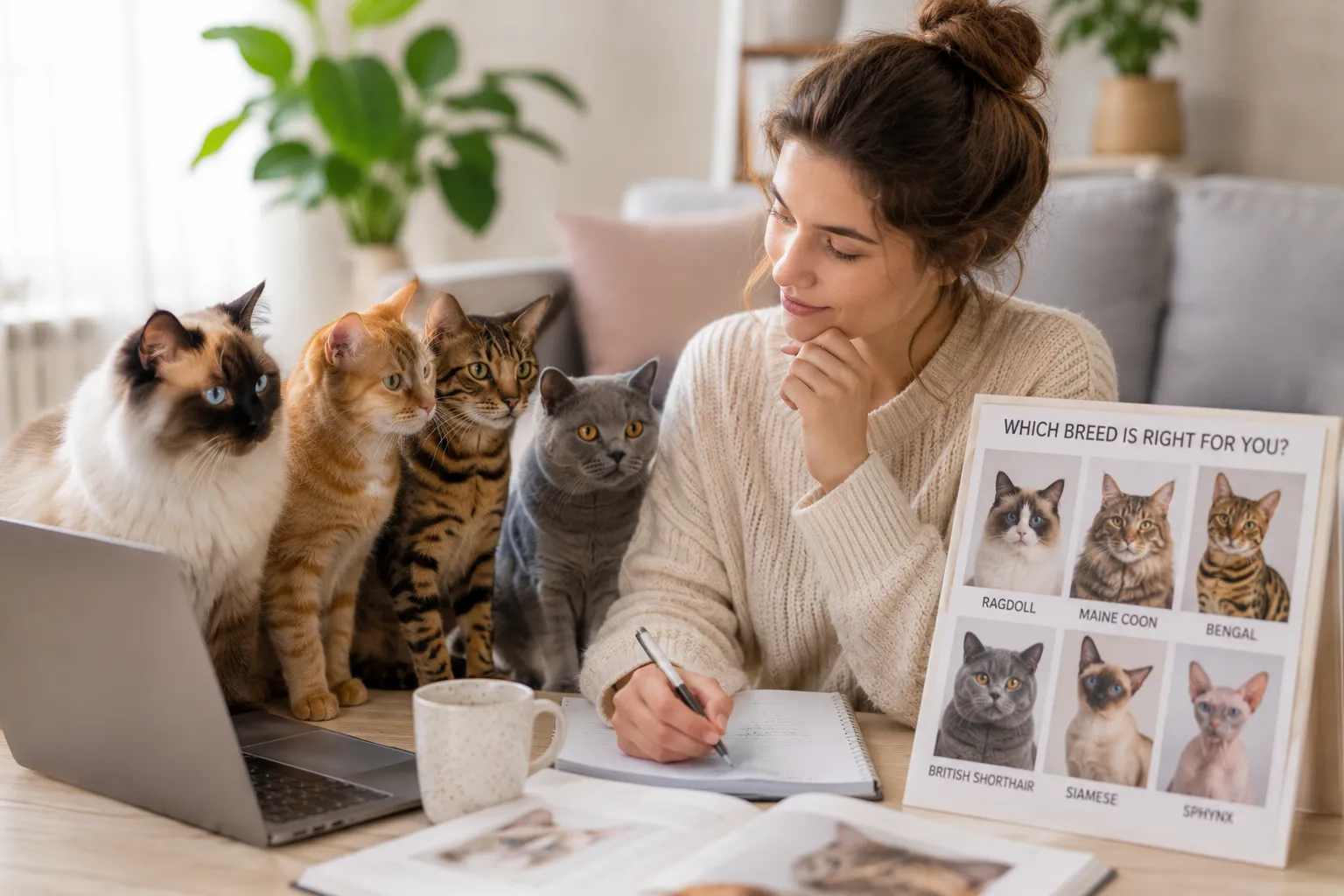
So, you have decided to get a cat. Congratulations! Your life is about to get infinitely weirder, furrier, and more entertaining. But now comes the hard part: how do you actually pick the right one?
Walk into any shelter or browse a breeder site and you will see dozens of breeds, each with their own fan club swearing theirs is THE best. The truth? There is no single "best" cat breed. There is only the best cat breed FOR YOU. And that depends on your lifestyle, your living space, your patience for vacuuming, and whether you are emotionally prepared for a 3 a.m. opera performance outside your bedroom door.
This guide breaks down exactly how to choose the right cat breed for your lifestyle — no fluff, no judgment, just real talk about which feline friend will actually fit into your world.
1. Why Breed (and Personality) Actually Matters
Here is the thing: all cats are chaos. But different breeds bring different flavors of chaos.
Some cats are basically decorative pillows with purring capabilities. Others are tiny athletes who will scale your curtains, open your cabinets, and judge your life choices out loud. Some need daily brushing and spa-level grooming. Others are wash-and-go. Some want to be attached to your hip 24/7. Others will treat you like a roommate they tolerate.
Understanding breed tendencies helps you set realistic expectations. It is not about finding a perfect robot pet — it is about finding a companion whose natural instincts align with what you can happily provide. A high-energy Bengal in a tiny studio with a workaholic owner? That is a recipe for shredded furniture and regret. A laid-back Persian with a busy family? Now we are talking.
The International Cat Association (TICA) recognizes over 70 distinct breeds, each with standardized temperament and care profiles. While every cat is an individual, breed traits give you a solid starting point for matching personality to lifestyle.
2. Start With Your Lifestyle — Not The Cute Photo
Before you fall in love with a fluffy face, ask yourself some honest questions. This is basically a dating app profile, but for cats.
How much space do you have?
A studio apartment and a five-bedroom house demand different cats. Small-space dwellers need breeds that are calm, quiet, and content with vertical territory (cat trees, shelves) instead of square footage.
How active are YOU?
If your idea of a wild weekend is binge-watching three seasons of a show, you probably do not want a cat that needs Olympic-level play sessions. If you are out hiking every morning, an active, curious breed might be your adventure buddy.
Do you have kids or other pets?
Some breeds are famously patient and social. Others prefer a quiet, adult-only household where they can rule in peace.
How much grooming can you handle?
Be real with yourself. Are you going to brush a long-haired cat daily? Or are you more of a “I barely brush my own hair” person? There is no shame in either — but there IS shame in letting a Persian mat because you got lazy.
Any allergies in the house?
No cat is 100% hypoallergenic, but some breeds produce less of the Fel d 1 protein that triggers allergies. If sneezing is a concern, this matters.
How much alone time will the cat have?
Some breeds handle solo time like champs. Others get lonely and destructive if left alone for 8+ hours daily.
3. Best Cat Breeds For Apartment Living
Living small does not mean living cat-less. You just need a breed that sees your studio as a palace, not a prison.
British Shorthair
The teddy bear of the cat world. Calm, independent, and quietly affectionate. They do not need tons of space, they rarely yowl at the neighbors, and they are happy to supervise your life from the couch. Think of them as a low-maintenance roommate who pays rent in cuddles.
Russian Blue
Elegant, intelligent, and naturally quiet. Russian Blues adapt beautifully to apartments because they are emotionally self-sufficient. They will bond deeply with you but will not demand constant entertainment. Plus, their short, silvery coat sheds minimally — great for small spaces with limited cleaning time.
Scottish Fold
Famous for their folded ears and sweet, owl-like expressions, Scottish Folds are gentle, adaptable, and low-energy. They are content in small spaces as long as they have a cozy perch and your occasional attention. They are also surprisingly quiet, which your neighbors will appreciate.
Ragdoll
Do not let their large size fool you — Ragdolls are basically giant marshmallows. They are calm, affectionate, and famously go limp when picked up. They do not need much space to roam because their favorite place is, quite literally, on you.
Persian
The ultimate lap luxury. Persians are low-energy, quiet, and perfectly happy in a small indoor kingdom as long as there is a soft cushion and a window to gaze from. Just be ready for daily brushing — that glamorous coat does not maintain itself.
4. Best Cat Breeds For Families With Kids
Kids are loud, unpredictable, and sometimes grabby. You need a cat with the patience of a saint and the durability of a stuffed animal.
Maine Coon
The gentle giant. Maine Coons are one of the largest domestic cat breeds, but they are famously patient, playful, and tolerant. They often act more like dogs — following kids around, playing fetch, and generally rolling with the chaos. Their thick coats do need grooming, but their easygoing nature makes them worth the brush time.
Ragdoll
We are mentioning them again because they are THAT good with kids. Their docile temperament and tendency to go floppy when held make them ideal for children who want a cuddle buddy. They rarely scratch or bite, even when subjected to questionable toddler fashion shows.
American Shorthair
The all-American classic. Friendly, adaptable, and sturdy enough to handle family life without falling apart. They are independent enough to take a break from kids when needed, but social enough to join the fun. Low grooming needs are a bonus for busy parents.
Birman
Sweet, social, and quietly playful. Birmans love being part of the family action but are not demanding about it. They are patient with children and get along well with other pets, making them a solid choice for bustling households.
Siamese
If your family loves interaction and conversation, a Siamese will fit right in. They are vocal, social, and form strong bonds with their humans. They thrive in busy households where there is always someone to talk to (or at). Just know they will loudly comment on everything you do.
5. Best Cat Breeds For Busy or First-Time Owners
Not everyone has hours to dedicate to pet care. If you want a cat that thrives on benign neglect, these breeds have your back.
British Shorthair
Yes, them again. They are the reigning champions of low-maintenance cat ownership. Independent, healthy, and happy to entertain themselves. They do not guilt-trip you for working late.
Russian Blue
Self-sufficient, clean, and quiet. Russian Blues are basically the introverts of the cat world — they love you, but they also value their alone time. Perfect for professionals who want companionship without clinginess.
Exotic Shorthair
Think of them as the lazy person's Persian. They have the same sweet, laid-back personality but with a short, easy-care coat. They are calm, affectionate, and do not require much beyond food, a clean litter box, and occasional chin scratches.
American Shorthair
Low grooming, low drama, high adaptability. They have been America's household cat for centuries for a reason. They are healthy, easygoing, and generally unfazed by life's disruptions.
6. Best Cat Breeds For Active, Adventurous Owners
If you want a cat that matches your energy — or at least provides entertainment while you drink coffee — these breeds bring the party.
Bengal
Wild looks, wild energy. Bengals are basically tiny leopards with a domestic cat's meal plan. They love climbing, exploring, playing in water (yes, really), and learning tricks. They need mental and physical stimulation daily. If you are not prepared to engage, they will redecorate your home out of boredom.
Abyssinian
One of the oldest known breeds and arguably the most curious. Abyssinians are always on the move — climbing, investigating, and inserting themselves into whatever you are doing. They are not lap cats; they are co-pilots. Great for owners who enjoy interactive play and a little feline chaos.
Siamese
Smart, vocal, and endlessly entertaining. Siamese cats need engagement and will create their own if you do not provide it. They can be trained to walk on a leash, play fetch, and open doors. They are perfect for people who want a cat with dog-like devotion and a talk-show host's personality.
Devon Rex
Mischievous, playful, and often described as "dog-like." Devon Rex cats are small, energetic, and love being the center of attention. They will follow you everywhere, learn tricks, and generally make life more interesting. Their short, wavy coat is also low-shedding.
Maine Coon
Yes, they are gentle giants, but they are also surprisingly playful and adventurous. Many Maine Coons enjoy water, leash walking, and outdoor exploration in safe enclosures. They are big enough to feel substantial but sweet enough to take anywhere.
7. Best Hypoallergenic Cat Breeds
Let us be clear: no cat is truly hypoallergenic. All cats produce Fel d 1, the protein that causes allergic reactions. However, some breeds produce less of it, shed less, or have coat types that spread fewer allergens around your home.
Sphynx
Hairless and high-maintenance in a different way. Without fur to trap oils, Sphynx cats need regular skin baths. But they produce minimal airborne allergens and are often tolerated by allergy sufferers. They are also warm, affectionate, and hilariously social.
Russian Blue
Their short, dense coat sheds very little, and some studies suggest they produce lower levels of Fel d 1. Many allergy sufferers report living comfortably with Russian Blues.
Balinese
A long-haired Siamese variant that, paradoxically, produces less Fel d 1 than many short-haired breeds. Their silky coat does not mat easily and sheds less than you would expect.
Siberian
Large, fluffy, and surprisingly allergy-friendly. Siberians are one of the few long-haired breeds often recommended for allergy sufferers due to lower Fel d 1 production. Their thick triple coat does need brushing, though.
Devon Rex / Cornish Rex
These curly-coated breeds have less fur overall, which means fewer allergens floating around. They are not guaranteed to solve allergies, but many people find them manageable.
8. The Case For Mixed-Breed and Shelter Cats
Here is a secret the breed clubs might not emphasize: some of the best cats in the world do not have a pedigree. Mixed-breed cats — often called domestic shorthairs or domestic longhairs — make up the vast majority of pet cats, and they are fantastic.
Shelter cats come with known personalities. Staff can tell you who is cuddly, who is playful, who is shy, and who will steal your socks. You get to match temperament to lifestyle without gambling on breed generalizations. Plus, adoption saves a life and typically costs a fraction of what a breeder charges.
If you have your heart set on a specific breed, check breed-specific rescues. Organizations exist for nearly every purebred — from Siamese to Maine Coons to Persians — and they are full of cats who need second chances.
9. Red Flags: Breeds To Avoid If...
Let us flip the script. Sometimes knowing what NOT to get is just as helpful.
Do NOT get a Persian or Himalayan if... you cannot commit to daily brushing and occasional face cleaning. Their flat faces can also mean breathing issues and tear staining.
Do NOT get a Bengal or Savannah if... you live in a small apartment, work long hours, or want a calm lap cat. These hybrids need space, stimulation, and engagement. Without it, they become destructive.
Do NOT get a Siamese or Oriental Shorthair if... you value silence or are away from home constantly. They are vocal and social. A lonely Siamese is a loud, unhappy Siamese.
Do NOT get a Sphynx if... you are not prepared for weekly baths and keeping your home warm. Hairless cats are high-touch pets.
Do NOT get a long-haired breed if... grooming is not your thing. Mats are painful and can lead to skin infections. Be honest about your maintenance capacity.
Frequently Asked Questions
Should I get a kitten or an adult cat?
Kittens are adorable but exhausting. They need training, constant supervision, and lots of socialization. Adult cats — especially those past the one-year mark — have established personalities, calmer energy, and often settle into routines faster. For first-time owners or busy households, an adult cat is often the smarter choice.
Male or female cat — which is better?
Personality matters more than gender. Neutered males are often laid-back and affectionate. Spayed females can be independent but deeply bonded. Either can be amazing. Focus on individual temperament, not sex.
How much does it cost to own a cat by breed?
Beyond the initial adoption or purchase price, factor in food, litter, vet care, grooming, and emergencies. Purebreds often have higher veterinary costs due to breed-specific health issues (like Persians with breathing problems or Maine Coons with heart conditions). Mixed-breed cats tend to be hardier and cheaper long-term.
Can I keep an active breed happy in an apartment?
Yes, but you need to work harder. Active breeds in small spaces need vertical territory, daily interactive play, puzzle feeders, and window entertainment. If you cannot provide enrichment, choose a lower-energy breed.
Is it better to get two cats instead of one?
If you are away from home often, two cats can keep each other company and prevent loneliness-driven behavior issues. Many shelters offer bonded pairs or "kitten buddies" who already get along. Two cats is not double the work — it is maybe 1.3x the work, with 2x the entertainment.
How do I know if a breeder is reputable?
Look for breeders registered with major associations like TICA or CFA. They should health-test their breeding cats, allow you to visit their facility, provide contracts with health guarantees, and ask YOU questions to ensure their kittens go to good homes. Run from anyone who has "always available" kittens, ships without meeting you, or refuses to show you the parents.
The Bottom Line
Choosing the right cat breed is not about finding the most popular or the prettiest. It is about finding the cat whose needs, energy, and personality mesh with your real life — not your fantasy life.
Be honest about your space, your schedule, your budget, and your patience. There is a cat out there who fits you perfectly. Maybe it is a dignified British Shorthair who judges your Netflix choices from the armchair. Maybe it is a chatty Siamese who follows you to the bathroom. Maybe it is a shelter mutt with one ear and a heart of gold.
Whatever you choose, remember: cats are not accessories. They are roommates, companions, and occasionally tiny tyrants who will steal your heart (and your warmest spot on the bed). Choose wisely, love fiercely, and enjoy every weird, wonderful moment.