
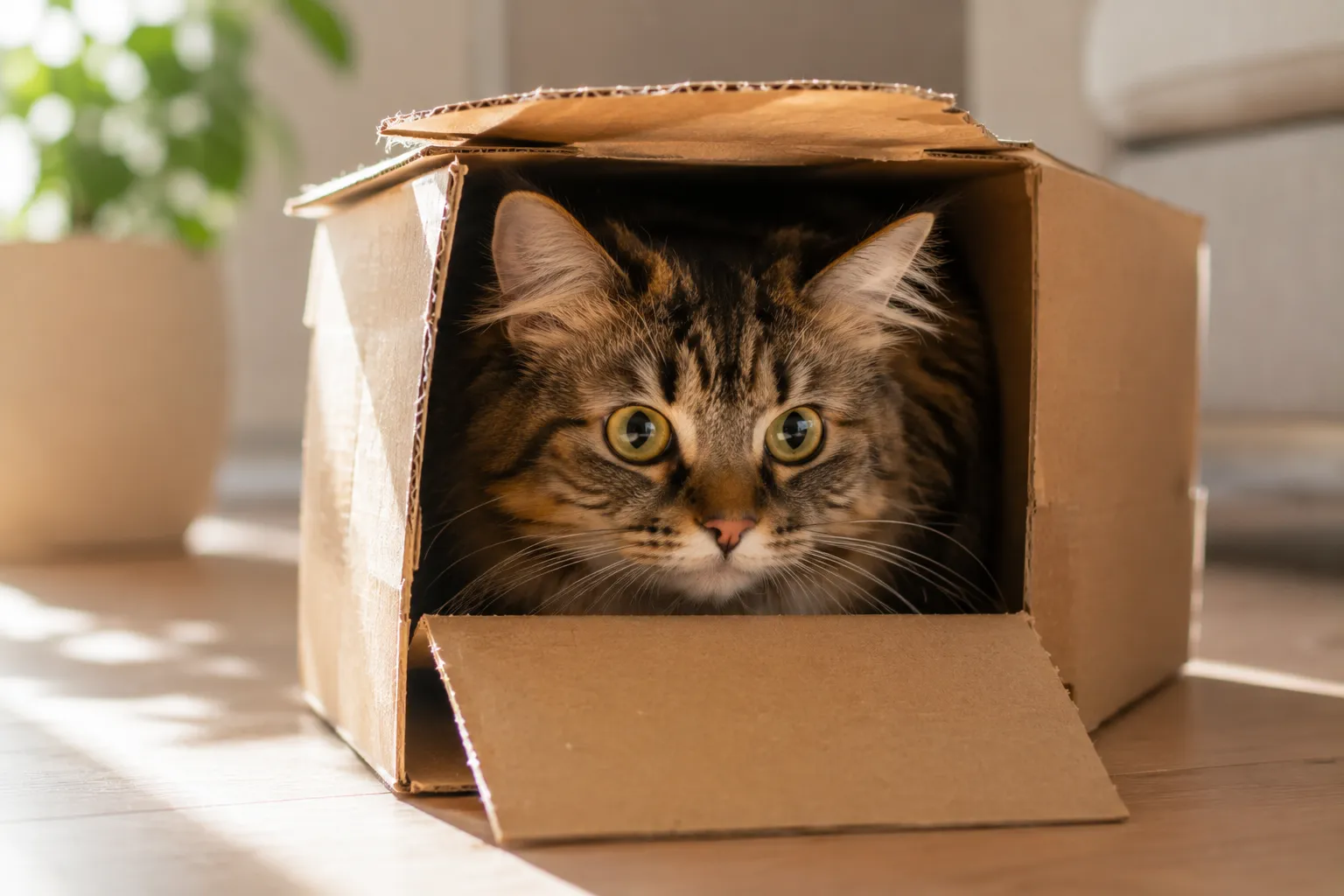
You spent $75 on a luxury cat bed with memory foam, a built-in heating pad, and a faux-fur lining so soft it would make a cloud jealous. Your cat looked at it, sniffed it once, and walked away. Then the Amazon box it arrived in sat on your floor for five minutes, and your cat is now living inside it like it is a penthouse suite with a view.
This is the universal cat owner experience. We buy the toys. They want the packaging. We buy the beds. They want the boxes. We buy the castles. They want the cardboard. And honestly? The science behind why cats love boxes is so fascinating that you might stop feeling insulted and start feeling impressed.
Let us unpack — pun absolutely intended — the real reasons your cat is obsessed with boxes, and why that free cardboard delivery container is basically feline therapy in a cube.
1. Safety And Security: The Box As Fortress
In the wild, cats are both predator and prey. They hunt small animals, but they are also hunted by larger predators like hawks, foxes, and coyotes. This dual identity means they are hardwired to seek out safe spaces where they can hide from threats and observe their surroundings without being seen.
A box provides exactly that. Four walls, a roof, and one opening facing outward. Your cat can see everything while being essentially invisible. From an evolutionary perspective, this is the perfect defensive position. According to PetMD, cats that roam free outside occupy a delicate midpoint in the food chain, and boxes mimic the bushes, burrows, and nooks that wild cats use to conceal themselves from both prey and predators.
Even indoor cats — who have never seen a hawk and whose biggest threat is the vacuum cleaner — retain this instinct. The box triggers a deep, primal sense of safety. When your cat is inside a box, their stress hormones drop, their muscles relax, and their brain basically says "I am safe now. Nothing can get me." It is a portable panic room, and it costs zero dollars.
2. Stress Relief: Boxes As Anxiety Medication
Here is something wild: studies have shown that providing boxes to shelter cats significantly reduces their stress levels. When researchers measured cortisol — the stress hormone — in newly arrived shelter cats, the ones given boxes had lower stress levels and adapted to their new environment faster than cats without boxes. PMC / NIH Study
A groundbreaking study published in Applied Animal Behaviour Science by researchers at Utrecht University found that cats with hiding boxes showed a significantly faster decrease in stress scores, reaching a calm baseline around day 3 — while cats without boxes took until day 14 to recover. ScienceDirect / Applied Animal Behaviour Science
Professor Claudia Vinke, an ethologist at Utrecht University and lead author, explained that hiding is a behavioral strategy cats use to cope with environmental changes and stressors. In the wild, threatened cats head for trees, dens, or caves. Captive indoor cats do not have that option, so a cardboard box becomes an adaptive substitute. Bark & Whiskers
Professor Danielle Gunn-Moore, a feline medicine expert at the University of Edinburgh, confirmed that stress hormones like cortisol drop measurably when cats have access to enclosed hiding spaces. The box does not just feel safe — it biochemically calms them down.
This is why your cat runs into a box when strangers visit, when you move furniture, or when the thunderstorm rolls in. The box is their emotional regulation tool. It is cheaper than Feliway and arguably more effective.
3. Hunting Instincts: The Perfect Ambush Spot
Cats are ambush predators. Their hunting strategy is not "run down the prey in a dramatic chase." It is "hide completely, wait motionless for an hour, and then explode out of nowhere like a furry missile." Boxes are basically purpose-built for this strategy.
According to feline behavior consultant Mikel Delgado, a senior research scientist at Purdue University, boxes offer the perfect hunting setup: walls that shield the cat from view and an open top that they can use to pounce onto potential prey. Your ankle, a toy mouse, or the dog walking by — all fair game for an ambush from the cardboard fort. VHA Veterinary Hospitals
Even if there is no actual prey, the box satisfies the instinct to hide and watch. A cat in a box is a cat who feels like they are doing their job. They are not just sitting in cardboard. They are operating a surveillance station.
4. Warmth: Cardboard Is A Tiny Heater
Cats love warmth. Their ideal body temperature is around 102 degrees Fahrenheit, and they are constantly seeking out heat sources — sunny windowsills, laptop keyboards, your freshly toasted face. Cardboard is an excellent insulator. It traps body heat and creates a cozy microclimate that is warmer than the surrounding room. Pet Health Network
A cardboard box is essentially a cat-sized sauna. The walls block drafts, the floor retains warmth, and the enclosed space means your cat's body heat stays put instead of dissipating into the room. For a creature who considers 70 degrees "a bit chilly," a box is a heated blanket that costs nothing and requires no electricity.
5. Curiosity And Novelty: New Box, New Kingdom
Cats are territorial creatures who notice every change in their environment. A new box is not just a box — it is a new territory to claim, explore, and conquer. They must sniff it, rub their cheeks on it to deposit scent marks, climb inside to test the acoustics, and possibly chew a corner just to establish dominance. Animal Medical Center NYC
Behaviorist Mikel Delgado notes that for a curious cat, a new box is "something fun and novel to investigate." It is a change in their environment, and cats are hardwired to investigate changes. Is it safe? Is it theirs? Can they fit inside? These are the questions that drive a cat to immediately occupy any new box that enters their domain.
6. Kittenhood Memories: The First Safe Space
A mother cat seeks out quiet, enclosed spaces to give birth. Kittens' first experience of the world is a warm, dark, protected den. That early imprinting creates a lifelong preference for enclosed spaces. A box recreates that den-like feeling — enclosed, warm, and safe. Kinship / Denning Behavior
Cats who had difficult upbringings or were weaned too early may be especially drawn to boxes because they provide the security they missed in early life. For these cats, a box is not just fun — it is essential emotional support.
7. The "If I Fits, I Sits" Phenomenon
Cats will cram themselves into boxes that are objectively too small for them. They will fold their limbs like origami, compress their bodies, and somehow make it work. Why?
Part of it is the pressure effect. The snug walls of a small box provide gentle pressure on their body, similar to a weighted blanket for humans. This pressure has a calming effect and can reduce anxiety. It also makes them feel more secure because there is less open space around them to monitor. Feline Behavior Solutions
Plus, cats are liquid. We do not make the rules. We just observe them.
8. When Box-Loving Becomes A Warning Sign
Most box-loving is healthy and normal. But sometimes, excessive hiding in boxes can signal a problem.
If your cat is hiding in boxes all the time — emerging only to eat and use the litter box — that is not normal. It could indicate chronic stress, fear, illness, or pain. Cats who feel unwell often retreat to hiding spots because their instincts tell them that vulnerability in the open is dangerous. West Greenwich Animal Hospital
Professor Vinke emphasizes that while cats need safe hiding spots, "for a cat to be hiding all the time, it is really not good." If your formerly social cat has become a box hermit, consult your veterinarian and possibly a veterinary behaviorist. Underlying medical issues, environmental stressors, or social conflicts in multi-cat homes could be the cause. Companion Animals NZ
Frequently Asked Questions
Why does my cat prefer the box over the expensive bed?
Because the box satisfies instincts that the bed does not. The box offers enclosure, warmth, security, and a hunting vantage point. Most cat beds are open and exposed, which makes a cat feel vulnerable. From a cat's perspective, a $75 open bed is a trap. A free cardboard box is a castle.
Is it safe for my cat to sleep in boxes?
Generally yes, but check for hazards. Remove tape, staples, rubber bands, or small plastic pieces that could be chewed or swallowed. Make sure the box is stable and not placed somewhere it could fall. Avoid boxes that have held toxic chemicals or strong cleaning products.
Why does my cat chew on cardboard boxes?
Some cats chew cardboard for texture, boredom, or dental relief. It is usually harmless in small amounts, but if your cat is ingesting large pieces, it could cause intestinal blockages. Provide safe chew toys and monitor their cardboard consumption. If chewing is excessive, consult a vet — it could indicate pica or dental issues.
Do all cats love boxes?
Most do, but not all. Some cats prefer open spaces, high perches, or soft blankets. Personality, early experiences, and individual preferences all play a role. A cat who does not like boxes is not broken — they just express their need for security differently.
Can I use boxes to help a new cat adjust?
Absolutely. Providing a box in a quiet corner gives a new cat an immediate safe zone where they can decompress. It reduces stress, gives them control over their environment, and helps them acclimate faster. Just make sure the box is in a low-traffic area where they will not be disturbed.
Why does my cat sit in boxes that are way too small?
Because they can. Cats have flexible spines and collarbones that allow them to compress their bodies into surprisingly tight spaces. The snugness also provides gentle pressure that feels calming and secure. Plus, it is a dominance thing — "I claimed this space and made it mine, regardless of physics."
Related CatCutieSweet Guides
The Bottom Line
Cats love boxes because boxes are everything a cat needs: a fortress, a hunting blind, a heated bed, a stress-relief tool, and a nostalgic reminder of their first safe den. Your cat is not rejecting your expensive gifts out of spite. They are following millions of years of evolutionary programming that says "enclosed space equals survival."
So the next time you unbox a delivery, do not immediately break down the cardboard for recycling. Leave it on the floor for 24 hours. Let your cat claim it, scent-mark it, and possibly take a nap inside. It is free enrichment, free therapy, and free entertainment. And when they inevitably abandon it three days later for a newer, shinier box? That is just cat logic. Roll with it.
After all, in a world of uncertainty, we could all use a box to hide in sometimes.