
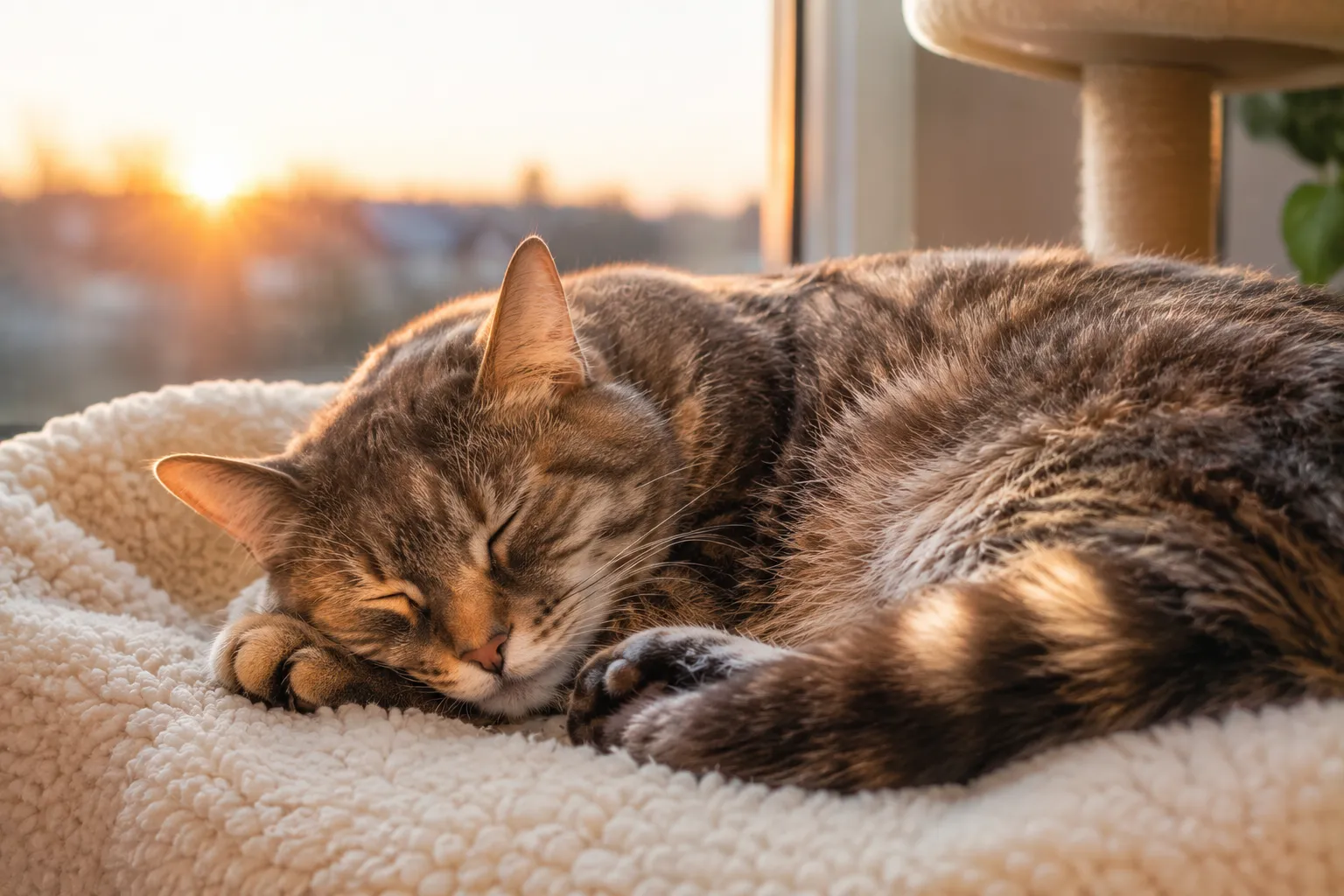
Your cat has slept through your entire workday. They napped through your morning coffee, your afternoon meetings, and that one Zoom call where you accidentally turned your camera on while eating a sandwich. Now it is 11 p.m., you are finally ready for bed, and your cat is suddenly wide awake, sprinting across the room like their tail is on fire and the floor is lava.
Welcome to the crepuscular lifestyle. If you have ever asked yourself, “why do cats sleep so much?” — you are not alone. The answer lies in millions of years of evolution, some very clever biology, and the fact that your cat simply does not care about your sleep schedule.
Let us break down the real reasons behind all that shut-eye, what crepuscular activity actually means, and when all that sleeping might be a sign that something is wrong.
1. The Numbers: Just How Much Do Cats Sleep?
The average cat sleeps anywhere from 12 to 18 hours a day. About 40% of cats will sleep even longer than that, clocking in at 20+ hours of daily snoozing. Senior cats and kittens tend to sleep the most — kittens because their bodies are growing at warp speed, and seniors because their energy reserves are running lower. PetMD
But here is the thing: cats do not sleep like humans. We tend to crash for one long, hopefully uninterrupted stretch of 7 to 9 hours. Cats sleep in short bursts — anywhere from 50 to 113 minutes at a time — scattered throughout the day and night. So while it looks like they are sleeping constantly, they are actually cycling through multiple sleep-wake periods. A cat nap is not a break from activity. It IS the activity.
According to WebMD, this pattern is deeply rooted in feline biology and has nothing to do with laziness. Your cat is not a loaf. They are a finely tuned predator with a very specific energy budget.
2. Crepuscular: The Word That Explains Everything
Cats are crepuscular, which means they are most active during twilight hours — dawn and dusk. This is when their wild ancestors hunted, and modern house cats have inherited that biological clock whether they realize it or not.
In the wild, dawn and dusk are prime hunting times because that is when prey animals — mice, birds, insects — are most active. A cat who sleeps all day and hunts at twilight is a cat who conserves energy for the moments when food is actually available. Even though your house cat has never hunted a day in their life and their “prey” is a kibble bowl that refills itself, the instinct remains hardwired.
This is why your cat gets the “zoomies” at 5 a.m. and again at 10 p.m. Their body is screaming HUNT TIME while you are screaming GO TO SLEEP. You cannot fight biology. You can only buy earplugs and invest in automatic feeders.
3. Energy Conservation: The Predator’s Budget
Cats are obligate carnivores, which means their diet is 100% meat. Hunting is metabolically expensive. Stalking, chasing, pouncing, and killing prey burns a massive amount of energy, and success is never guaranteed. A wild cat might expend enormous effort on a hunt and come home empty-pawed.
Sleeping allows cats to bank energy for those high-intensity bursts. Think of it like a sprinter resting between races. Your cat is not lazy — they are strategically conserving fuel for the moments when they need to explode into action. Even if their “action” is just batting at a toy mouse for three minutes before getting bored.
This energy conservation strategy is why cats can go from zero to sixty in seconds. They are not out of shape. They are just operating on a different metabolic schedule than humans.
4. What Happens While They Sleep? A Lot, Actually
Sleep is not downtime for a cat’s body. It is maintenance mode. While your cat is curled up in a sunbeam, their body is busy with serious repair work:
- Immune system boosting: Sleep strengthens the immune response, helping cats fight off infections and stay healthy.
- Muscle repair: Those explosive hunting bursts create micro-tears in muscle tissue. Sleep is when the body repairs and rebuilds.
- Memory consolidation: Cats process and store memories during sleep, converting short-term experiences into long-term learning. This is especially important for kittens who are absorbing huge amounts of information about their world.
- Growth hormone release: In kittens, sleep triggers the release of growth hormones essential for development.
- Digestive and immune system restoration: The body diverts energy to internal repair and regulation during rest periods. Kowaliga Veterinary Care
So the next time you feel guilty about your cat sleeping all day, do not. They are basically running a biological software update.
5. The Two Types Of Cat Sleep
Not all cat sleep is created equal. Cats cycle between two distinct sleep states:
Light Sleep (Cat Napping)
This is the default mode — eyes closed, body relaxed, but senses still on standby. A cat in light sleep can spring into action in milliseconds if they hear a can opener or a suspicious floorboard creak. Their ears rotate toward sounds, their whiskers twitch, and their tail might flick in response to stimuli. This is survival sleep — restful but alert. About 75% of a cat’s sleep time is spent in this state. The Cat Behavior Clinic
Deep Sleep (REM Sleep)
During deep sleep, cats experience Rapid Eye Movement — the same dream state humans have. You will see their eyes moving behind closed lids, their paws twitching, their whiskers quivering, and sometimes they make small vocalizations. This is when their brain processes memories and emotions. Deep sleep only lasts about 5 to 10 minutes per cycle, but it is essential for mental health and cognitive function. Fear Free Happy Homes
If you see your cat twitching in their sleep, resist the urge to wake them. They are dreaming — probably about murdering that bird they saw through the window — and interrupting REM sleep is disorienting and stressful.
6. Boredom: The Indoor Cat’s Sleep Trap
Here is a reality check: some cats sleep excessively because they are bored out of their minds. Indoor cats without adequate stimulation have very little reason to stay awake. There are no birds to stalk, no mice to chase, no territories to patrol. So they sleep. A lot. San Francisco SPCA
Excessive sleeping from boredom is often accompanied by other signs: overgrooming, excessive vocalization, destructive behavior, or weight gain. A bored cat is not a happy cat, even if they look peaceful curled up on the couch. They need environmental enrichment — puzzle feeders, interactive toys, window perches, and daily play sessions — to keep their brains engaged and their sleep patterns healthy.
7. When Sleeping Too Much Is A Red Flag
Most cat sleep is normal. But sometimes, excessive sleep signals an underlying problem. If your cat’s sleep patterns suddenly change — sleeping significantly more or less than usual — it is worth investigating.
Medical conditions that cause increased sleep include:
- Arthritis: Painful joints make movement exhausting, so cats sleep more to avoid discomfort. Cornell Feline Health Center
- Infections: The body sleeps more to divert energy to the immune system.
- Diabetes: Blood sugar fluctuations cause lethargy and increased sleep.
- Kidney disease: A common condition in older cats that causes fatigue and weakness.
- Hyperthyroidism: Ironically, this can cause either increased or decreased sleep depending on the cat.
- Cancer: Many cancers cause fatigue and reduced activity levels.
Behavioral and age-related causes:
- Senior cats: Older cats naturally sleep more as their metabolism slows and energy levels drop.
- Dementia / cognitive dysfunction: Senior cats may experience sleep disturbances, confusion, and increased nighttime activity.
- Depression: Cats can experience depression, which manifests as lethargy, appetite changes, and excessive sleeping.
If your cat is sleeping more than usual AND showing other symptoms — appetite loss, weight changes, vomiting, diarrhea, increased thirst, or behavioral changes — schedule a vet visit. Sudden sleep changes are often one of the earliest signs that something is off.
8. Managing The Nighttime Crazies
If your cat’s crepuscular energy is destroying your sleep, there are ways to shift their schedule — slightly. You will never turn a cat into a diurnal creature, but you can reduce the 3 a.m. parkour sessions.
Evening play session: Spend 15 to 20 minutes with an interactive wand toy before bed. Mimic hunting behavior — let them stalk, pounce, and “catch” the toy. Then feed them a small meal. The hunt-eat-groom-sleep cycle is powerful. A tired, full cat is a sleepy cat.
Automatic feeder: If your cat wakes you up for breakfast, an automatic feeder that dispenses food at dawn can break the association between you and mealtime. They will learn to harass the machine instead of your face.
Daytime enrichment: Keep your cat awake and active during the day with puzzle feeders, window perches, and rotating toys. A cat who sleeps all day will party all night. A cat who is mentally stimulated during the day will sleep more soundly at night. Acacia Pet Clinic
Ignore attention-seeking behavior: If your cat yowls or knocks things over at night for attention, do not respond. Any reaction — positive or negative — reinforces the behavior. Earplugs and patience are your friends.
Frequently Asked Questions
Is it normal for my cat to sleep 20 hours a day?
For some cats, yes — especially seniors, kittens, and certain breeds. However, if this is a sudden change from their normal pattern, or if it is accompanied by other symptoms like lethargy or appetite loss, consult your vet. Context matters more than the number itself.
Why does my cat sleep on me?
Because you are warm, soft, and smell like safety. Sleeping on you is a sign of trust and affection. In multi-cat households, cats who sleep together are bonded. If your cat chooses your lap or chest as their bed, consider yourself honored. You are part of their colony.
Do cats dream?
Yes. During REM sleep, cats experience brain activity patterns similar to humans, and their physical reactions — twitching paws, whisker movements, vocalizations — suggest they are processing experiences and possibly dreaming. What they dream about is anyone’s guess, but it probably involves hunting, exploring, or judging you.
Why does my cat sleep in weird positions?
Cats sleep in positions that regulate body temperature and provide security. A cat curled in a tight ball is conserving heat and protecting their vulnerable belly. A cat sprawled on their back with legs in the air is overheated and feels completely safe in their environment. The weirder the position, the more secure they feel.
Should I wake my cat up if they are twitching in their sleep?
No. Twitching during sleep is normal REM activity. Waking a cat from deep sleep is startling and stressful. Let them dream in peace. If the twitching is violent, prolonged, or accompanied by vocalizations that sound distressed, that is different — consult a vet. But normal dream-twitching is harmless.
Why is my cat more active at night?
Because they are crepuscular. Dawn and dusk are their natural hunting hours. Indoor cats may also be more active at night because they slept all day while you were at work. The solution is more daytime enrichment and an evening play session to burn off energy before bed. VCA Hospitals
The Bottom Line
Cats sleep a lot because they are biologically designed to. Their crepuscular nature, predator energy conservation strategy, and the simple fact that sleep is when their body repairs and restores itself all add up to a creature who spends two-thirds of their life unconscious. It is not laziness. It is efficiency.
The key is knowing the difference between normal cat sleep and excessive sleep that signals a problem. A cat who sleeps 16 hours, plays hard for two, and then zooms around at dawn is healthy. A cat who suddenly starts sleeping 22 hours, ignores their favorite toys, and seems lethargic when awake needs a vet check.
So let your cat sleep. Let them dream of whatever cats dream about. And when they wake up at 5 a.m. ready to hunt imaginary prey through your hallway, just remember: you signed up for this. You are living with a tiny predator whose ancestors hunted at dawn while yours were still figuring out fire. The least you can do is respect the nap schedule.
Curious about more feline mysteries? Browse our guides to why cats purr, why cats knead, and why cats love boxes.