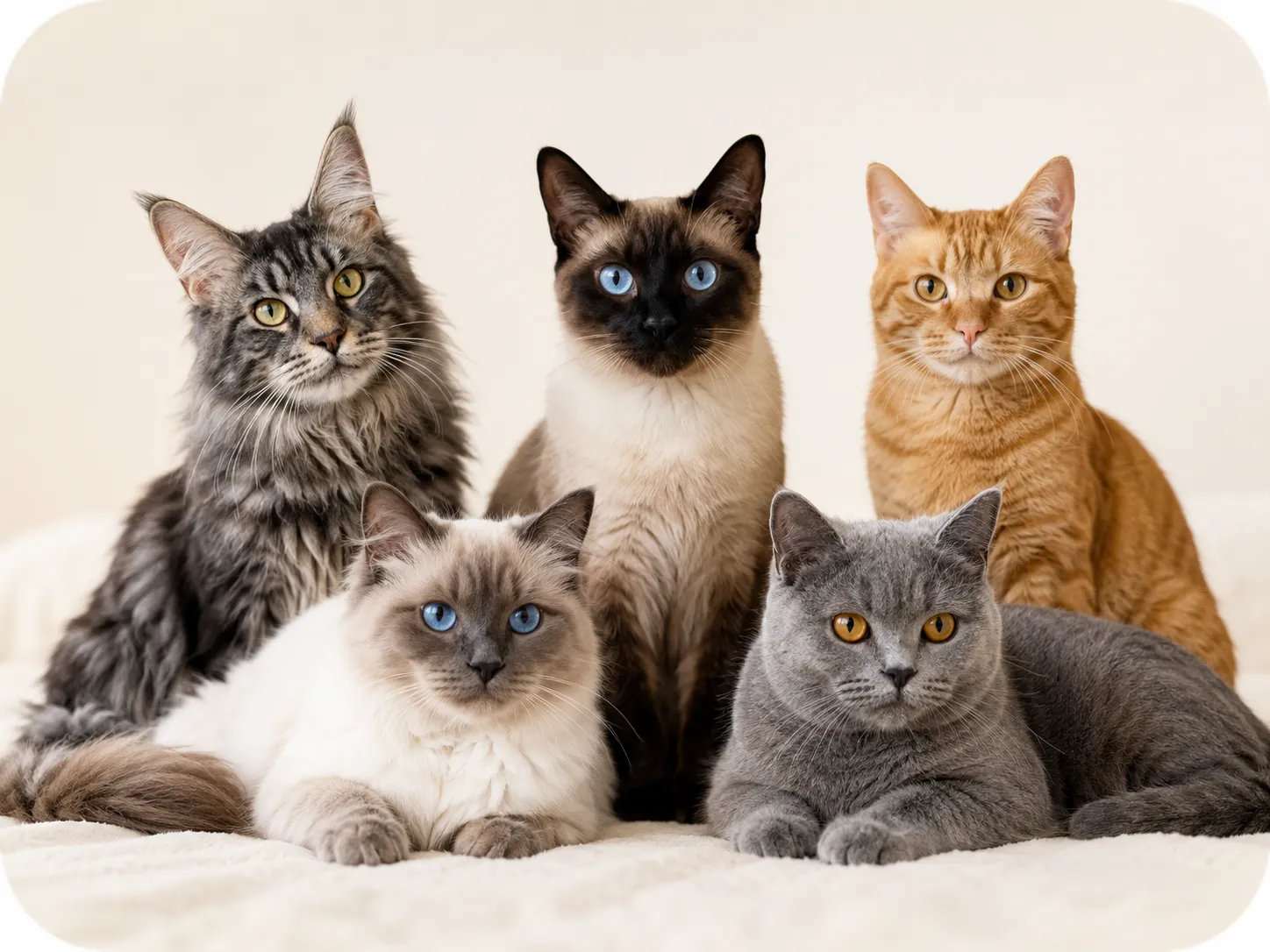
How To Pick The Best Cat Breed For You
Learn how to choose the right cat breed for your lifestyle, home, family, activity level, grooming expectations, and long-term care needs.
Read article →
Breed Profile
Learn about the Siamese cat's Thai origin, vocal personality, short coat, pointed coloring, care needs, health considerations, and whether this intelligent breed is right for your home.
Thailand
Medium
Short
6 to 14 pounds
12 to 20 years
Low
Moderate to high
Active families, attentive adults, gentle children, and homes that enjoy an interactive cat
The Siamese is one of the world’s most recognizable cat breeds, known for its vivid blue eyes, short coat, pointed coloring, and highly social personality. Many Siamese cats form strong bonds with their people and enjoy being included in daily life.
This breed is often described as intelligent, vocal, affectionate, and curious. A Siamese may follow you from room to room, comment on household activity, and look for regular play, attention, and mental stimulation. They can be wonderful companions for people who want an interactive cat rather than a quiet background pet.
The Siamese cat is one of the oldest and most influential breeds in the cat world. Its roots reach back to Thailand, formerly known as Siam, where pointed cats were known as Wichianmat or Wichien-maat. These cats developed as a naturally occurring landrace rather than as a modern breed created in a breeder’s cattery.
One of the most important historical references to Siamese-type cats appears in the Tamra Maew, often translated as the Cat-Book Poems. These Thai manuscripts describe and illustrate treasured cats, including pale-bodied cats with darker points on the ears, face, paws, and tail. The cats shown in these manuscripts resemble the traditional Siamese type and help explain why the breed is often described as one of the oldest documented cat breeds.
Thai tradition also gave Siamese cats a sense of mystery and prestige. Stories connected them with temples, royal households, and spiritual symbolism. Some legends claimed that a royal person’s soul could enter a favored cat after death, while another story explained the old crossed eyes and kinked tails by saying the cats guarded precious goblets so intensely that their eyes crossed and their tails curled around the base. These traits are not encouraged in modern breeding, but the legends remain part of Siamese folklore.
The breed’s reputation as the “Royal Cat of Siam” is partly history and partly Western marketing. Siamese cats were admired in Thailand and associated with status, but evidence also suggests they were not kept only by royalty. Their striking appearance and exotic image made them especially fascinating to European and American cat fanciers in the late 1800s.
The first widely documented Siamese cat in the United States was a cat named Siam, sent in 1878 by David B. Sickels, the American consul in Bangkok, to Lucy Webb Hayes, wife of President Rutherford B. Hayes. Siam’s arrival at the White House helped introduce Americans to the breed.
In Britain, the breed became established after Edward Blencowe Gould, the British Consul-General in Bangkok, brought a breeding pair named Pho and Mia to England in 1884 as a gift for his sister, Lilian Jane Gould. Their kittens were shown at London’s Crystal Palace, where the unusual pointed cats attracted attention. Some early reactions were harsh because Victorian cat fanciers were more used to rounder, heavier breeds, but curiosity soon grew into lasting admiration.
By the early 1900s, Siamese cats had a devoted following in Britain and North America. The Siamese Cat Club was founded in Britain in 1901, and the breed became one of the early favorites of organized cat fancy. Over time, Siamese cats helped shape several other breeds, including the Balinese, Oriental Shorthair, Tonkinese, Himalayan, Snowshoe, and Colorpoint Shorthair.
During the first half of the twentieth century, Siamese cats generally had a moderate body, a graceful build, and a less extreme head shape. In the 1950s and 1960s, show preferences began to favor a slimmer, more angular cat with a long wedge-shaped head, large ears, a tubular body, and a whip-like tail. This led to a visible difference between the Modern Siamese seen in many show rings and the Traditional Siamese or Thai-style cat preserved by breeders who preferred the older look.
Today, the Siamese remains famous for much more than appearance. Its long history, strong personality, and genetic influence make it one of the most important breeds in the development of modern pedigree cats.
| Year | Milestone |
|---|---|
| 1351-1767 | Siamese-type Wichianmat cats are associated with the Tamra Maew manuscripts from historic Siam. |
| 1878 | A Siamese cat named Siam is sent to First Lady Lucy Webb Hayes in the United States. |
| 1884 | Edward Blencowe Gould brings the breeding pair Pho and Mia from Bangkok to Britain. |
| 1885 | Pho, Mia, and their kittens are shown at London’s Crystal Palace. |
| 1898 | Wankee becomes an important early champion Siamese in Britain. |
| 1901 | The Siamese Cat Club is founded in Britain. |
| Early 1900s | Siamese cats become established in organized cat fancy in Britain and North America. |
| 1950s-1960s | Show preferences increasingly favor the slender Modern Siamese type. |
| 1980s and later | Traditional Siamese-type cats are preserved and recognized by some registries as Thai cats. |
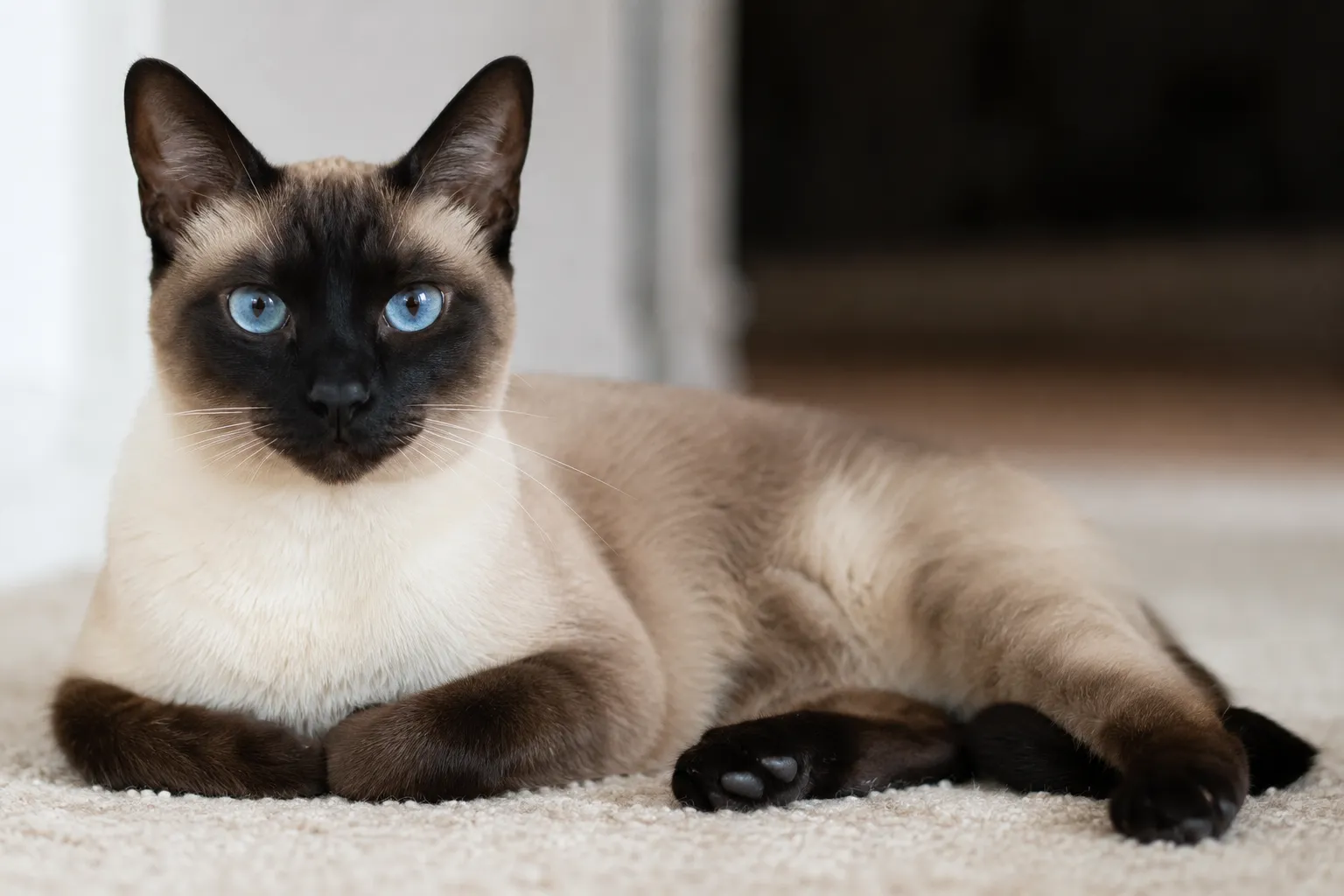
Siamese cats are elegant, medium-sized cats with short coats, blue eyes, and pointed coloring. The pointed pattern means the cooler areas of the body, such as the ears, face, legs, paws, and tail, are darker than the warmer body color.
Traditional Siamese cats tend to have a more moderate body and head shape. Modern Siamese cats usually have a longer, slimmer body, a wedge-shaped head, large ears, and a very refined profile. Both types are connected to the same broader history, but registry standards may treat them differently.
Common Siamese point colors include seal, chocolate, blue, and lilac. Some registries also recognize additional point colors or related colorpoint breeds depending on their standards.
Siamese cats are famous for being social, expressive, and people-focused. Many want to be close to their families and may follow their favorite person around the home. They are often described as talkative because they use distinctive vocalizations to ask for attention, food, play, or companionship.
This breed usually does best in a home where people enjoy interaction. A bored Siamese may become demanding or mischievous, so daily play, puzzle toys, climbing spaces, and social time are important. Many Siamese cats also enjoy learning routines, playing fetch, or investigating anything new in the home.
Siamese cats are usually active and intelligent, so they need both physical and mental enrichment. A good daily routine can help them stay happy and confident.
A Siamese-friendly home often includes:
Because Siamese cats are often strongly bonded to people, they may not enjoy being ignored for long stretches. Some do well with another compatible cat or pet companion, but introductions should always be gradual and supervised.
The Siamese coat is short, fine, and generally easy to maintain. Weekly brushing can help remove loose hair, reduce shedding, and keep the coat sleek. Many Siamese cats enjoy gentle grooming when it is introduced calmly.
Routine care should also include nail trimming, dental care, ear checks, and regular veterinary wellness visits. Because the coat is short, grooming is usually less demanding than it is for longhaired breeds.
Siamese cats can be long-lived, but like all breeds, they may be associated with certain inherited or breed-related health concerns. Responsible breeders should be willing to discuss health history, screening practices, and any known risks in their lines.
Some Siamese and related lines have been associated with conditions involving the teeth, respiratory system, eyes, liver, and heart. Not every Siamese will experience these issues, but routine veterinary care and early attention to changes in behavior, appetite, weight, breathing, or litter box habits are important.
This page is educational and should not replace veterinary advice. If your Siamese has sudden changes in energy, appetite, vocalization, mobility, breathing, or behavior, contact a veterinarian.
A Siamese may be a good match if you want a social, intelligent cat that enjoys conversation, play, and close companionship. They often suit people who want a lively indoor cat and are happy to provide daily attention.
A Siamese may not be ideal if you prefer a very quiet, independent cat that rarely asks for interaction. Their affectionate and vocal nature is part of their charm, but it can feel intense for someone who wants a low-maintenance companion.
Helpful Answers
Siamese cats originated in Thailand, formerly known as Siam, where pointed cats known as Wichianmat appeared in historic Thai cat manuscripts.
Many Siamese cats are famously vocal and expressive. They often use a wide range of sounds to communicate with their people.
Wichianmat is commonly translated as Moon Diamond, a poetic Thai name associated with the traditional Siamese-type cat.
Siamese cats have temperature-sensitive pointed coloring, so cooler areas of the body usually develop darker color than the warmer body.
Many Siamese cats are affectionate, social, and playful, which can make them good companions for families that provide attention, enrichment, and respectful handling.
Keep Learning