How To Pick The Best Cat Breed For You
Learn how to choose the right cat breed for your lifestyle, home, family, activity level, grooming expectations, and long-term care needs.
Read article →
Breed Profile
Learn about the Ragdoll cat's California origin, gentle personality, blue eyes, semi-long coat, grooming needs, health considerations, and whether this affectionate breed is right for your home.
United States
Large
Semi-long
10 to 20 pounds
12 to 17 years
Moderate
Low to moderate
Families, gentle children, calm homes, and many cat-friendly pets
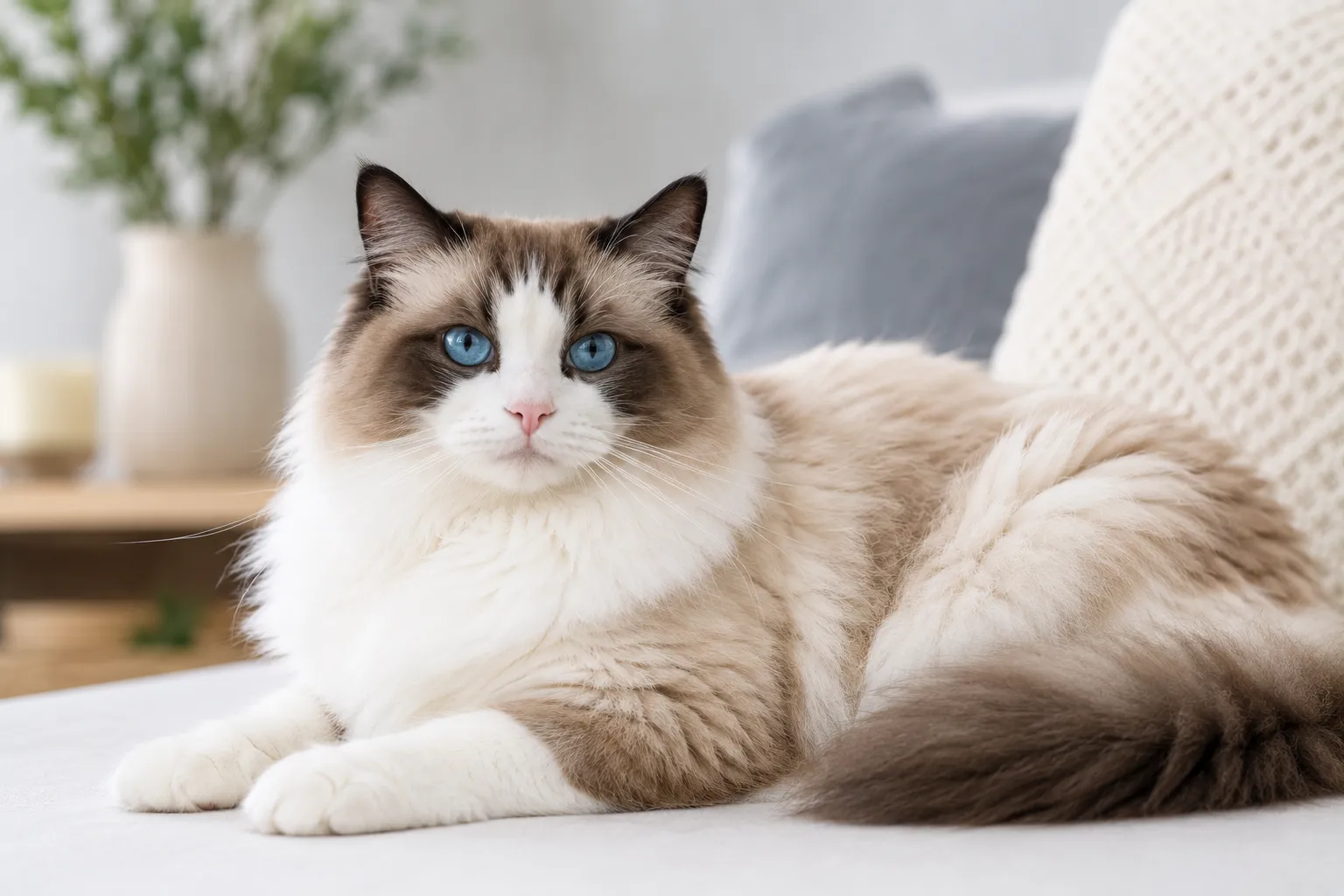
The Ragdoll is a large, affectionate cat breed known for its blue eyes, soft semi-long coat, and calm, people-focused personality. Many Ragdolls enjoy following their people from room to room, relaxing nearby, and being part of daily family life without being overly demanding.
This breed is often described as gentle and easygoing, but it is still important to remember that every cat is an individual. A Ragdoll’s behavior depends on genetics, early socialization, home environment, health, and the way people interact with them.
The Ragdoll is one of the newer recognized cat breeds, with an origin story that is almost as distinctive as the cats themselves. The breed began in Riverside, California, in the early 1960s through the work of breeder Ann Baker.
At the center of the Ragdoll story was Josephine, a white, longhaired neighborhood cat often described as an Angora-type or Persian-type cat. Josephine produced kittens that appeared unusually relaxed, affectionate, and tolerant when handled. Baker became interested in these traits and began developing a breed around the kittens’ gentle temperament, soft semi-long coat, and striking pointed appearance.
One of the most repeated stories about the breed claims that Josephine’s temperament changed after she was hit by a car. This story became part of early Ragdoll folklore, but it should be understood as legend rather than proven science. A cat’s personality can be shaped by genetics, socialization, and environment, but an accident would not rewrite inherited breed traits. The Ragdoll’s temperament is better explained by selective breeding from cats that showed the calm, people-oriented qualities Baker wanted to preserve.
The early foundation cats included Josephine’s descendants, especially Daddy Warbucks, Fugianna, Buckwheat, and Blackie. Daddy Warbucks, a seal mitted male, became especially important in the development of the breed. Fugianna and Buckwheat represented two of the early family lines that Baker used as she worked to establish the Ragdoll’s appearance and personality.
The breed name “Ragdoll” came from the cats’ tendency to relax heavily in a person’s arms, almost like a soft rag doll. Although not every Ragdoll goes completely limp when picked up, the name captured the calm, trusting temperament that helped make the breed famous.
Ann Baker was protective of the breed and created her own registry, the International Ragdoll Cat Association. Her strict control over the name and breeding program eventually led some breeders to separate from her system. Among the most important were Denny and Laura Dayton of Blossom-Time cattery, who acquired Ragdolls from Baker in 1969 and later helped document pedigrees, standardize the breed, and guide it toward recognition by mainstream cat associations.
The Ragdoll gradually gained wider recognition beyond its California beginnings. The breed was imported into the United Kingdom in 1981 by Pat Brownsell and Lulu Rowley, and the Governing Council of the Cat Fancy recognized the breed nine years later. In the United States and internationally, Ragdolls continued to grow in popularity through major registries, including The International Cat Association and The Cat Fanciers’ Association.
Today, the Ragdoll is known for its blue eyes, soft semi-long coat, large body, and affectionate, people-focused personality. Its history matters because the breed was developed not only for appearance, but also for temperament. The gentle, companionable nature associated with many Ragdolls is one of the main reasons the breed has become one of the most popular pedigreed cats in the world.
| Year | Milestone |
|---|---|
| Early 1960s | Ann Baker begins developing the Ragdoll breed in Riverside, California. |
| 1965 | Early kittens associated with the Ragdoll name are born. |
| 1966 | Early Ragdolls, including Daddy Warbucks, Fugianna, Kyoto, and Tiki, are registered. |
| 1969 | Denny and Laura Dayton acquire their first Ragdolls from Ann Baker. |
| 1970s | The Daytons begin helping move the breed toward mainstream recognition. |
| 1981 | The first Ragdolls are imported into the United Kingdom. |
| 1990 | GCCF recognizes the Ragdoll in the UK. |
| 1993 | CFA accepts Ragdolls for registration. |
| 2000 | CFA advances Ragdolls to championship status. |
Ragdolls are large, sturdy cats with a soft, semi-long coat and a rounded, gentle expression. Their vivid blue eyes are one of the breed’s most recognizable features. Traditional Ragdolls are pointed cats, meaning the ears, face, legs, tail, and other cooler areas of the body are darker than the body color.
Common Ragdoll patterns include colorpoint, mitted, and bicolor. Coat colors may include seal, blue, chocolate, lilac, red, cream, and variations with lynx or tortie markings depending on the registry standard.
Ragdolls are often known for being calm, affectionate, and strongly bonded to their people. Many enjoy quiet companionship, gentle attention, and predictable routines. They are sometimes described as dog-like because they may greet family members, follow people through the home, or enjoy being close without being overly pushy.
Because Ragdolls are typically trusting and people-oriented, they are usually best kept as indoor cats or given access only to safe, enclosed outdoor spaces. Their relaxed nature can make them wonderful companions, but they still need enrichment, play, and respectful handling.
Ragdolls do best with a steady routine, quality nutrition, regular veterinary care, and daily interaction. Even though many Ragdolls are calm, they still benefit from play sessions, puzzle toys, climbing spaces, scratching posts, and cozy resting spots.
A good home setup for a Ragdoll often includes:
The Ragdoll coat is semi-long and soft. It may not mat as quickly as some heavier longhaired coats, but regular brushing is still important. Brushing helps reduce loose fur, prevent tangles, and keep the coat comfortable.
Most Ragdolls benefit from brushing two to three times per week, with more frequent grooming during seasonal shedding. Nail trimming, dental care, ear checks, and routine veterinary wellness visits should also be part of their care plan.
Ragdolls can be healthy, long-lived cats, but responsible breeding and routine veterinary care matter. Ask breeders about health testing, family history, and whether their cats are screened for known inherited risks. One condition associated with the breed is hypertrophic cardiomyopathy, a form of heart disease that can affect cats.
This page is educational and should not replace veterinary advice. If your Ragdoll has changes in appetite, breathing, litter box habits, energy level, weight, or behavior, contact a veterinarian.
A Ragdoll may be a good match if you want an affectionate indoor companion and can provide regular grooming, gentle attention, and a calm home routine. They often suit people who enjoy a cat that wants to be nearby and involved in family life.
A Ragdoll may not be ideal if you want a highly independent outdoor cat or a very high-energy breed that spends all day climbing, racing, and exploring. While Ragdolls can be playful, their charm usually comes from their relaxed, companionable nature.
Helpful Answers
The Ragdoll breed was developed by Ann Baker, a breeder in Riverside, California, during the early 1960s.
Josephine was the white, longhaired neighborhood cat whose kittens became central to the early development of the Ragdoll breed.
The breed was named for its tendency to relax when held, similar to the way a soft rag doll goes limp.
Many Ragdolls are affectionate, calm, and people-oriented, which can make them good companions for gentle families. As with any cat, personality, socialization, and respectful handling matter.
CFA accepted Ragdolls for registration in 1993 and later advanced the breed to championship status in 2000.
Keep Learning