
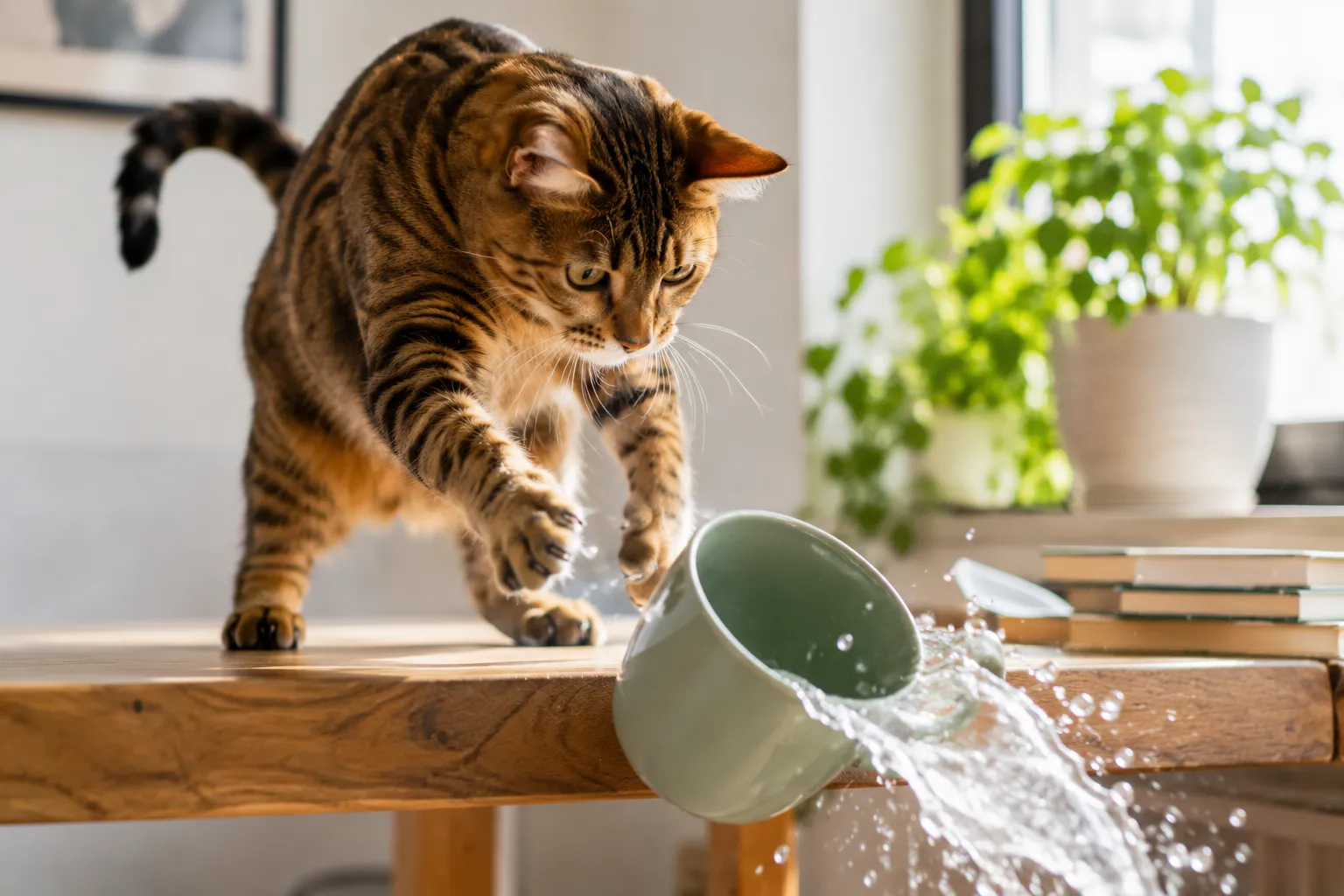
You are on a Zoom call, trying to look professional while wearing sweatpants, when you hear it. The slow, deliberate scrape of a paw against glass. You turn. Your cat is sitting on the coffee table, one paw resting on your full water glass, making direct eye contact with you. They blink. You blink. Then — with the precision of a calculated war crime — they push the glass off the edge.
It shatters. Water goes everywhere. Your cat looks at you, then at the mess, then back at you with an expression that says “what?”
This is the table-knocking phenomenon, and every cat owner knows it. But why do cats knock things off tables? Is it malice? Boredom? A physics experiment? The answer is all of the above, plus millions of years of evolutionary programming that tells them “small moving object equals prey.”
Let us break down the real reasons cats knock things off tables, what is going on in their chaotic little brains, and how to redirect the behavior before you run out of drinking glasses.
1. Predatory Instincts: Your Pen Is Prey
At its core, table-knocking is hunting behavior. Cats are obligate carnivores and natural predators. Their paws are precision instruments designed for capturing, manipulating, and killing prey. When they encounter a small object on a surface — especially one that moves, rolls, or makes noise when touched — their predatory drive kicks in automatically.
This behavior mirrors how cats would bat at small animals in the wild. The swatting motion allows them to test whether something is alive, assess its weight and stability, and determine if it is worth pursuing. Your pen, your jewelry, or that decorative rock you brought back from vacation becomes an unwitting stand-in for a mouse or insect. Chewy
Motion triggers a cat’s predatory instincts. When you set a glass on the counter and it catches the light, or when a pen rolls slightly, your cat’s brain screams PREY and their paws act before their higher reasoning catches up. Certified cat behaviorist Pam Johnson-Bennett describes it as similar to a toddler dropping items from a high chair — it is all about the excitement of movement and cause-and-effect. Countryside Veterinary Clinic
2. Sensory Exploration: Paws As Research Tools
Cats experience the world primarily through their paws and whiskers. Their paws are packed with nerve endings that provide detailed information about texture, weight, temperature, and movement. When a cat bats at an object, they are not just playing — they are conducting research. Vetic Veterinary
Hard objects feel different from soft ones. Light items move differently than heavy ones. The sound of glass hitting tile versus plastic hitting carpet provides different data points. Each knocked-over object teaches your cat something new about their environment. What looks like destructive behavior to us is actually sophisticated environmental analysis to them.
Think of it as feline science. Your cat is a researcher, your coffee table is the lab, and your possessions are the test subjects. The methodology is questionable, but the curiosity is genuine.
3. Gravity Is Fascinating
Let us be honest: gravity is pretty cool, especially when you do not fully understand it. Cats seem genuinely intrigued by the fact that things fall when pushed. The trajectory of a pen rolling off a desk, the bounce of a rubber ball, or the satisfying crash of something breakable all provide entertainment and mental stimulation.
This fascination with cause and effect is not unique to cats, but their particular combination of curiosity, precision paws, and access to elevated surfaces makes them excellent gravity experimenters. Each knocked-over object provides new data about how the physical world works. Your cat is basically a furry physicist with a grant funded by your homeowner’s insurance deductible.
4. Attention-Seeking: They Know Exactly What They Are Doing
Cats are remarkably intelligent when it comes to understanding cause and effect, particularly regarding human behavior. If knocking something off a table consistently gets you to jump up, make noise, or rush over to them, your cat has learned a valuable lesson: this behavior works. Cats.com
Certified cat behaviorist Katenna Jones explains that cats discover positive attention and negative attention both satisfy their need for interaction. Whether you are praising them, scolding them, or simply engaging with them after they have knocked something over, you are reinforcing the behavior. From their perspective, mission accomplished.
This is why your cat often looks at you while pushing the object. They are not checking if you are watching. They are checking because you are watching. The eye contact is part of the performance. They know the glass is about to fall. They know you are about to react. And they know that your reaction — any reaction — is the real prize.
5. Boredom: Creating Their Own Entertainment
Cats are bright, inquisitive, and athletic. If their environment is too mundane or they do not have enough enrichment, they will create their own entertainment. And sometimes that entertainment involves physics experiments with your possessions.
Certified cat behaviorist Stephen Quandt notes that “cats are easily bored, and so knocking things over becomes a type of play-based behavior.” Indoor cats without adequate mental and physical stimulation may turn to table-clearing as a way to create engagement and release pent-up energy. A bored cat is a destructive cat, and your water glass is just the nearest available toy.
6. Hunger: The Dinner Bell Gambit
Sometimes, knocking things over is a not-so-subtle hint that it is mealtime. If your cat consistently pushes objects off surfaces around their usual feeding time, they may be trying to communicate hunger. It is their way of saying “I am starving, and if you do not feed me immediately, your favorite mug is next.”
If this pattern is consistent, check with your vet to make sure your cat is getting adequate nutrition. If they are genuinely hungry despite appropriate portions, there could be an underlying medical issue like hyperthyroidism or diabetes. If they are just dramatic — which, let us be real, most cats are — an automatic feeder can break the association between you and mealtime.
7. Territory And Control: Rearranging Their Domain
Cats are territorial creatures who like to maintain control over their environment. Knocking objects off surfaces can be a way of rearranging their space to their preferences. By moving or removing items, they are essentially redecorating according to their own specifications.
This behavior is particularly common when new objects appear in familiar spaces. Your cat might knock over a new decoration, book, or houseplant as a way of saying “I did not approve this addition to my territory.” It is their way of quality-controlling changes to their domain. Some experts also believe the behavior can be a form of territorial marking — a physical assertion that they control the space.
8. Stress And Anxiety: When Mischief Becomes A Cry For Help
Sometimes, destructive behaviors escalate when cats feel stressed, anxious, or understimulated. A cat who suddenly begins knocking over more objects than usual might be expressing frustration about changes in their routine, environment, or social situation.
New pets, moving homes, schedule changes, or even rearranged furniture can trigger increased table-knocking. The behavior becomes an outlet for pent-up energy and frustration. If your cat’s table-clearing suddenly intensifies alongside other stress signals — hiding, excessive grooming, aggression, or litter box issues — address the underlying stressor or consult a veterinary behaviorist.
9. How To Stop The Chaos: Redirect, Do Not Punish
You cannot eliminate a cat’s instinct to bat at objects. But you can redirect the behavior and make your surfaces less appealing as playgrounds.
Remove Temptation
Clear valuable, fragile, or dangerous items from accessible surfaces. This is not surrendering to your cat’s demands — it is practical problem-solving. If there is nothing interesting to push, there is nothing to push.
Provide Better Alternatives
Create designated play areas with objects your cat IS allowed to bat around. Puzzle feeders, interactive toys, track toys, and even empty boxes can satisfy their need to manipulate objects with their paws. Experts recommend toys like the Catit Senses Digger or the TRIXIE Activity Fun Board to redirect paw-based exploration appropriately.
Increase Playtime
Schedule consistent interactive play sessions — 10 to 20 minutes daily with a wand toy or laser pointer. A tired, satisfied cat is less likely to seek entertainment through destructive means. Burn their predatory energy before they burn your security deposit.
Ignore Attention-Seeking Behavior
If your cat is knocking things over primarily to get your attention, responding in any way reinforces the pattern. When possible, ignore the behavior completely. Do not look, do not speak, do not react. Pick up the item later when your cat is not watching. Attention is oxygen to this behavior — starve it.
Use Deterrents Wisely
Double-sided tape, aluminum foil, or motion-activated deterrents can make surfaces less appealing for pawing. However, these should be short-term training tools paired with enrichment. A stressed cat with nowhere to play will find other ways to express frustration. Deterrents alone do not solve the root cause.
Clicker Training
Use positive reinforcement to teach “leave it” and “drop it” commands. Clicker training with high-value treats can redirect your cat’s attention away from forbidden objects and toward rewarded behaviors. Consistency is key — everyone in the household needs to use the same cues and rewards.
Frequently Asked Questions
Do cats knock things over to annoy us?
No. They are not being malicious or spiteful — they are being cats. The behavior is driven by instinct, curiosity, boredom, or learned reinforcement. Your cat does not understand the sentimental value of your grandmother’s figurine. They just see a small object that moves interestingly when pushed.
Why does my cat look at me while knocking things over?
Because they have learned that your reaction is the best part. The eye contact is a check-in: “Are you watching? Good. Here comes the grand finale.” It is performance art, and you are the audience. The most effective response is no response at all.
Is it normal for kittens to knock things over more than adult cats?
Yes. Kittens and young adults have higher energy levels and less impulse control. They are also still learning about their environment and practicing motor skills. Most cats calm down somewhat with age, though some retain their table-clearing hobbies for life.
Can I train my cat to stop knocking things over completely?
Probably not completely — the instinct is too deeply wired. But you can significantly reduce the behavior by removing temptations, providing alternatives, increasing playtime, and ignoring attention-seeking attempts. Consistency and patience are essential.
My cat only knocks things over when I am on the phone or working. Why?
Because you are ignoring them, and they have figured out exactly how to fix that. This is classic attention-seeking behavior. Your cat has learned that your focus on a screen or conversation makes you unavailable, and knocking something over is a guaranteed interruption. The solution is preemptive attention — a play session before you start working — and ignoring the behavior when it happens.
Are certain cat breeds more likely to knock things over?
High-energy, intelligent, and curious breeds like Bengals, Siamese, Abyssinians, and Maine Coons may be more prone to table-knocking because they need more stimulation and are more likely to explore their environment. But any cat with paws and access to a surface can — and will — participate in this behavior.
The Bottom Line
Cats knock things off tables because their brains are programmed to investigate small moving objects, their paws are built to manipulate prey, and they have learned that your reaction is endlessly entertaining. It is not malice. It is not spite. It is millions of years of predatory instinct colliding with modern apartment living and your unfortunate choice of glassware.
The good news? This behavior is manageable. Remove temptations, provide appropriate outlets for predatory energy, increase playtime, and — hardest of all — ignore the attention-seeking performances. Your cat is not trying to drive you crazy. They are just following evolutionary programming that tells them “bat first, ask questions later.”
So stock up on plastic cups, invest in a good toy collection, and maybe bolt down anything irreplaceable. Your cat is a scientist, a hunter, and a chaos agent all in one fluffy package. And honestly? That is part of why we love them. Even when they are costing us a fortune in drinking glasses.
If your cat’s chaos is stressing you out, read our guide to designing a cat-friendly home. For more on feline instincts, see why cats love boxes and eat grass. Explore our full cat behavior guides.