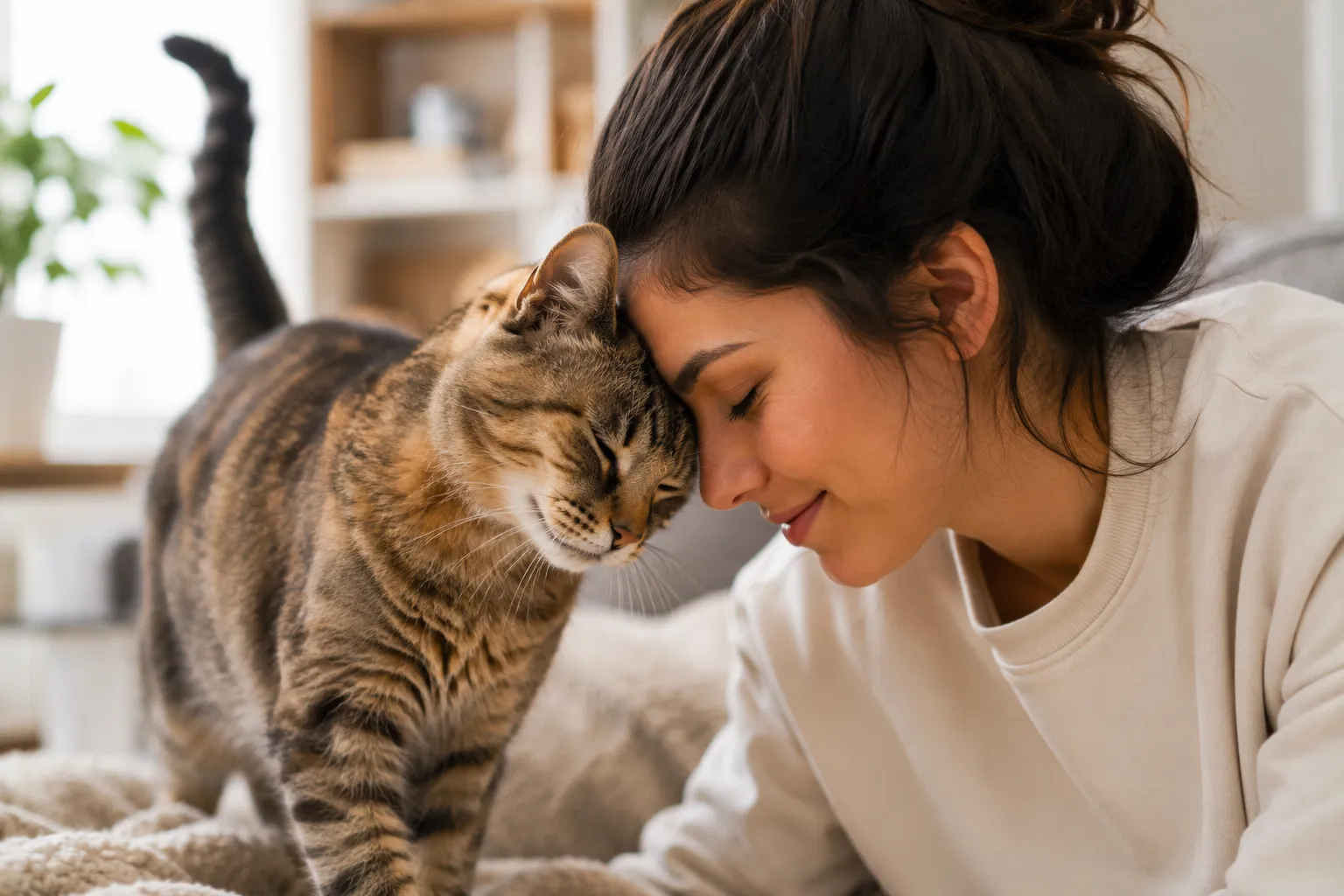
You are scrolling on your phone, minding your own business, when suddenly — THWACK — a small furry forehead collides with your chin. Your cat looks up at you with half-closed eyes, purring like a motorboat, and then rubs their cheek against your face with the intensity of a person trying to remove a stubborn stain.
Congratulations. You have just been bunted.
If you have ever wondered, “why do cats head butt you?” — the answer is both simpler and more complex than you think. Cat head-butting, officially called “bunting,” is one of the most endearing and slightly confusing behaviors in the feline repertoire. It looks aggressive — after all, in human culture, a head-butt is basically a declaration of war. But in cat culture, it is a love letter written in pheromones. It is trust, affection, territory, and communication all wrapped into one gentle skull collision.
Let us decode what bunting really means, why cats do it, and why you should probably feel honored instead of concussed.
1. What Is Bunting, Exactly?
Bunting is when a cat presses their forehead, cheeks, or chin against a person, object, or another animal and rubs. The technical term is “allorubbing” when directed at other cats, and it serves the same purpose: scent exchange and social bonding. PetMD
Cats have scent glands all over their bodies, but the ones involved in bunting are concentrated on the face — specifically around the cheeks, forehead, chin, and just in front of the ears. When your cat head-butts you, they are not just being pushy. They are depositing pheromones — chemical signals that communicate information to other cats and, interestingly, provide emotional comfort to the cat doing the marking.
According to Purina, these facial pheromones have a calming and reassuring effect. When a cat rubs their face on something, they are essentially saying “this is mine, this is safe, this is familiar.” And when that something is YOU? That means you have been officially inducted into their inner circle.
2. Scent-Marking: You Have Been Claimed
Let us get one thing straight: when your cat head-butts you, they are marking you as territory. But before you get offended, understand that in cat language, this is the highest compliment.
Cats use scent to navigate their world. Their sense of smell is roughly 14 times more powerful than a human’s, and they rely on scent marks to identify safe spaces, familiar individuals, and social group members. When your cat deposits facial pheromones on you, they are creating a “colony scent” — a shared smell that identifies you as part of their social group. The Spruce Pets
This is fundamentally different from territorial marking like urine spraying, which is a defensive “keep out” signal. Facial marking via bunting is a positive, affiliative behavior. It says “you belong to me, and I belong to you.” Think of it as a friendship bracelet, but invisible and smell-based.
In multi-cat households, cats who get along will bunt each other to create a shared colony scent. This communal smell helps them recognize each other as family rather than intruders. When your cat bunts you, they are treating you the same way they would treat a bonded feline companion. You are part of the crew.
3. Affection And Trust: The Head-Butt As Love Language
Head-butting is a vulnerable behavior. To bunt you, a cat must get close, lower their guard, and expose their face — one of their most sensitive and important body parts. They will not do this with someone they distrust.
Bunting is just one of many ways cats communicate affection. Learn more in our guides to why cats purr and why cats knead.
When your cat head-butts you, they may also purr, slow-blink, or flop over playfully. These are all signs of contentment. The head-butt is not just a mechanical scent-depositing action. It is an affectionate gesture, a cat’s version of a hug or a kiss. Some cats deliver gentle cheek rubs. Others come in hot with a full skull-to-skull clunk. Either way, the message is the same: “I love you, you are mine, and I feel safe with you.”
4. Self-Soothing: Bunting As Emotional Regulation
Here is something most people do not realize: cats also bunt objects when they are alone. They rub their face on furniture, door frames, cat trees, and pretty much anything that holds still long enough. This is not just territorial marking. It is self-soothing.
The act of releasing facial pheromones has a calming effect on the cat doing it. It is similar to how kneading triggers endorphin release. When a cat bunts their favorite chair or your leg, they are not just claiming ownership — they are regulating their own emotional state. The familiar scent they deposit makes their environment feel safer and more predictable.
This is why synthetic feline facial pheromone diffusers like Feliway work. They mimic the calming chemicals cats release during bunting, essentially creating an artificial “everything is fine” signal in the environment. Your cat’s face is basically a portable anxiety-reduction device.
5. Attention-Seeking: The Strategic Head-Butt
Sometimes, a head-butt is not just affection. It is a demand.
If your cat head-butts you while you are on your phone, working at your desk, or otherwise ignoring them, they are probably saying “hello, I am here, and I require your immediate attention.” Cats are intelligent enough to learn that bunting gets a response. If you consistently pet them, talk to them, or get up to feed them after a head-butt, they will use it as a tool.
This creates a positive feedback loop. The more you respond to bunting with attention and affection, the more your cat bunts. It becomes a mutually reinforcing cycle of love and validation. Which, honestly, is not the worst problem to have.
6. Investigating New People: The Cautious Bunt
If a cat you do not know well head-butts you, they are not necessarily declaring eternal love. They might just be gathering information.
Cats use scent to learn about their environment, and that includes new humans. A tentative head-butt from an unfamiliar cat is often an exploratory behavior — a way to sniff you, test your reaction, and decide whether you are trustworthy. Move slowly, offer your hand for a sniff, and let them set the pace. If they follow up with cheek rubs and purring, you have been approved. If they back away, give them space. Not every cat wants to be friends immediately.
7. Head-Butting Vs. Head Pressing: Know The Difference
This is critically important. Head-butting is a normal, healthy behavior. Head pressing is not.
Head-butting (bunting): Brief contact, usually accompanied by rubbing, purring, relaxed body language, and slow blinking. The cat is engaged, responsive, and appears content. They may head-butt you and then wander off, or they may stick around for pets.
Head pressing: The cat stands with their head pressed against a wall, corner, or piece of furniture for extended periods. They appear unresponsive, disoriented, or distressed. This is often accompanied by other neurological symptoms like pacing, vision changes, or seizures.
Head pressing can indicate serious neurological conditions, including brain tumors, liver disease, toxin exposure, or infections. If you see your cat pressing their head against a wall and they cannot be easily distracted, seek emergency veterinary care immediately. This is not a behavior to wait on. Cats.com Head Pressing
If you notice neurological symptoms, consult our article on designing a cat-friendly home to reduce environmental stressors, and speak with your vet promptly.
8. Why Does My Cat Head-Butt Everything Except Me?
Not all cats are bunters. Some show affection through other behaviors: purring, kneading, slow blinking, following you from room to room, or simply sitting near you looking judgmental. If your cat does not head-butt you, it does not mean they do not love you. It just means they express their feelings differently.
Some cats are more reserved due to genetics, early experiences, or individual personality. A cat who was not properly socialized as a kitten may never become a head-butter. That is okay. Bonding happens on the cat’s terms, not yours.
Frequently Asked Questions
Should I head-butt my cat back?
You can try, but be gentle and watch their reaction. Some cats love it when you lean in and offer your forehead. Others will give you a look that says “excuse you.” Let your cat lead. If they press into you, press back softly. If they pull away, respect their boundaries. Cat consent is real.
Why does my cat head-butt me and then bite me?
This is usually “petting-induced aggression” or overstimulation. Your cat was enjoying the interaction, reached their threshold, and switched from affectionate to annoyed. Watch for warning signs: tail twitching, ear rotation, dilated pupils, or a sudden stillness. Stop petting before the bite happens.
Do cats head-butt other cats?
Yes, and it is a great sign. Cats who head-butt each other are bonded and creating a shared colony scent. In multi-cat households, mutual bunting indicates social harmony. If your cats bunt each other and then groom each other, you have hit the feline friendship jackpot.
Why does my cat head-butt my phone?
Because your phone is stealing your attention, and your cat is not having it. A head-butt to your phone is a demand for you to look at THEM instead. It is also a way of marking the phone as part of their territory — “this device smells like me now, and so do you.”
My cat used to head-butt me but stopped. Why?
Sudden changes in bunting behavior can indicate stress, illness, or changes in your relationship. Have you changed soaps, perfumes, or detergents? Cats are sensitive to scent changes. Is there a new pet or person in the home? Is your cat showing other signs of illness? If the change is sudden and unexplained, a vet check is a good idea.
Why do cats head-butt furniture?
To mark it as safe and familiar. When cats bunt furniture, door frames, and walls, they are creating a scent map of their territory. This “friendly marking” makes their environment feel secure. It is the opposite of urine spraying, which is defensive and stressful. Facial marking is a cat’s way of saying “I live here, and everything is fine.”
The Bottom Line
When your cat head-butts you, they are doing something profound. They are marking you as family, depositing chemicals that make them feel safe, expressing trust and affection, and possibly demanding dinner. All at once. In a single forehead press.
Bunting is one of the most complex and meaningful behaviors cats display. It bridges scent communication, social bonding, emotional regulation, and attention-seeking into one compact, slightly bony gesture. The next time your cat clunks their skull against your chin, do not flinch. Lean in. Offer your forehead. And appreciate that you have been chosen as worthy of their scent, their trust, and their love.
Just maybe keep an ice pack nearby for the enthusiastic head-butters. Love hurts sometimes. Literally.
Want to deepen your bond? Explore our complete library of cat behavior guides.