
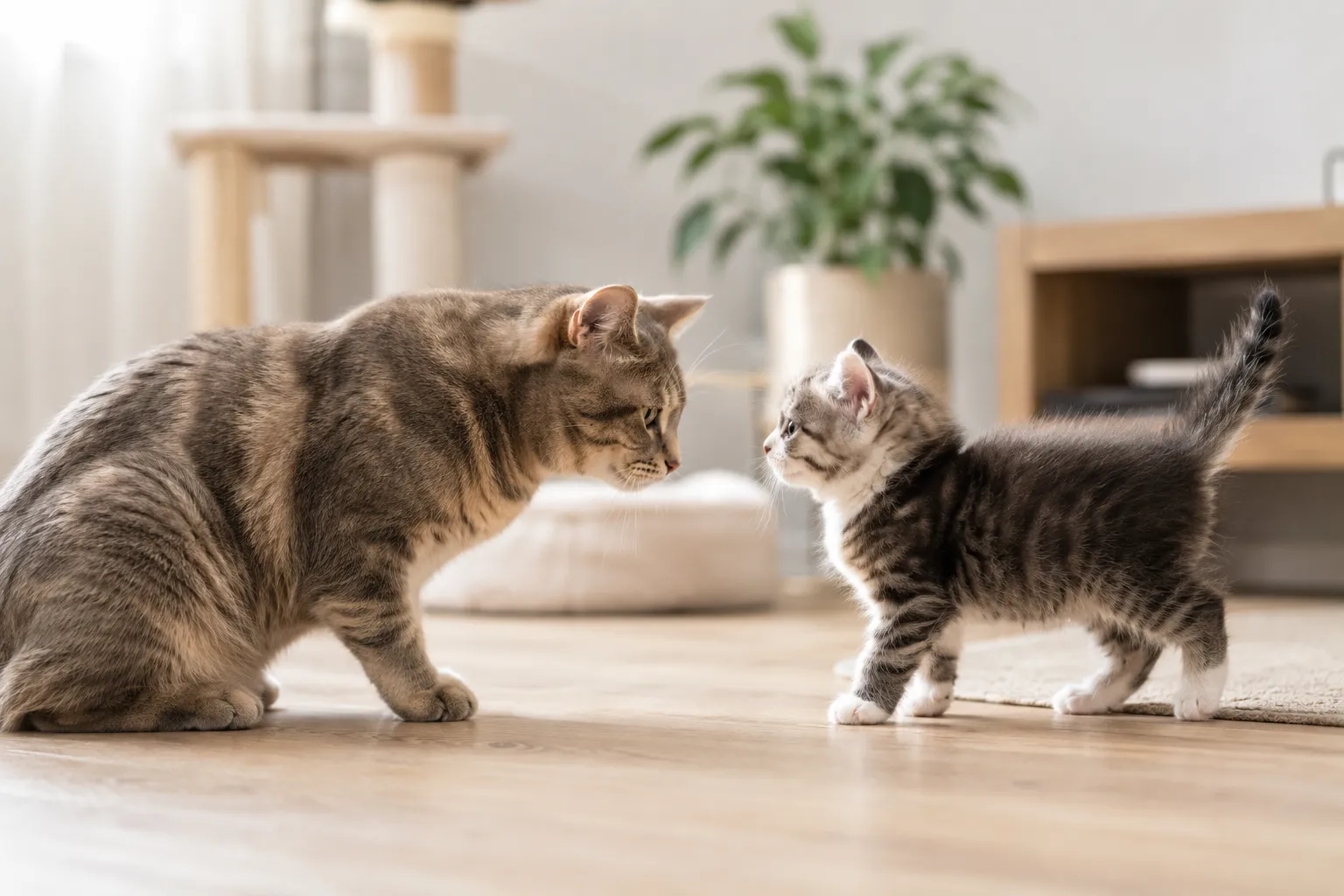
So you brought home a kitten. You pictured instant best-friend energy — maybe a Disney moment where your older cat gently licks the baby's head while birds sing outside. Instead, your resident cat just hissed at a sock that smelled like the newcomer and is now plotting your demise from atop the fridge.
Welcome to multi-cat life! The good news? Most cats can learn to coexist, and some even become ride-or-die cuddle buddies. The bad news? It takes patience, strategy, and the emotional maturity to not rush things because the kitten is "so cute." Cats are territorial creatures with strong opinions about personal space, and throwing them together blindly is how you end up with urine-soaked carpets and a grumpy vet bill.
This guide walks you through exactly how to introduce a new kitten to your cat — step by step, no shortcuts, and with a heavy emphasis on reducing territorial stress from day one. Follow this process and your odds of a peaceful multi-cat household go from "maybe" to "probably."
1. Why You Cannot Just Throw Them Together
Let us get one thing straight: cats are not dogs. They do not greet strangers with tail wags and butt sniffs. They are hardwired for territoriality, and your home is your resident cat's kingdom. When a bouncy little intruder shows up unannounced, that triggers a full-blown biological stress response.
When cats feel threatened, their bodies flood with stress hormones like cortisol and adrenaline. This is not just "being moody" — it is a legitimate physiological reaction that can cause urinary tract issues, appetite loss, vomiting, diarrhea, and even viral flare-ups. Behaviorally, stressed cats become aggressive, destructive, or withdrawn. A bad first impression can set the tone for months, if not years.
According to veterinary behaviorists at UC Davis Veterinary Medicine, first impressions between cats are lasting impressions. Early negative interactions require significantly more work to reverse than a slow, careful introduction takes to do right the first time. So yes, this process is annoying. But it is way less annoying than listening to cats fight at 2 a.m. for the next decade.
2. Prep Your Home Before The Kitten Arrives
Preparation is everything. You cannot wing a cat introduction and expect it to go well.
Set Up a Kitten Safe Room
Choose one quiet room — a spare bedroom, bathroom, or office — and make it the kitten's private suite for the first few days (or weeks). This room needs:
- Food and water bowls (placed away from the litter box)
- A low-sided litter box the kitten can easily climb into
- A cozy bed or hiding spot — an open cat carrier on its side works great
- A scratching post and a few safe toys
- A window perch if possible
Keep this door closed. The resident cat should not have direct access to the kitten's room during the initial settling period. This gives the baby time to adjust to new smells and sounds without being overwhelmed, and it protects your older cat's sense of territory.
Consider Pheromone Support
Plug in a synthetic feline facial pheromone diffuser (like Feliway) in both the kitten's room and the main living area a few days before introductions begin. These diffusers mimic the calming chemicals cats release when they rub their cheeks on things, essentially telling their brains "this space is safe." It is not a magic wand, but it takes the edge off for both cats.
Gather Your Gear
You will need baby gates (stack two if your cat is a jumper), a sturdy carrier, interactive toys like feather wands, and treats — lots of treats. Think of this as a diplomatic summit, and you are the mediator with a snack budget.
3. The Scent Swap: Let Them Smell Before They See
Cats experience the world primarily through scent. Their noses are packed with olfactory receptors, and they use smell to identify friends, foes, and furniture. Before any visual meeting happens, you need to turn the "new cat smell" from "intruder alert" into "oh, that guy again."
Start by taking a soft cloth or blanket and gently rubbing it on the kitten's cheeks, back, and sides. Do the same with a separate cloth on your resident cat. Then swap them. Place the kitten-scented cloth near your resident cat's favorite sleeping spot or food bowl, and vice versa. Let them investigate at their own pace.
If your resident cat hisses at the cloth, do not panic. That is normal. Move the cloth farther away and gradually inch it closer over the next day or two. You can also swap bedding, toys, or even litter boxes (scooped clean, obviously) between the two rooms. The goal is for both cats to eat, sleep, and relax around the other's scent without showing signs of extreme stress — like flattened ears, raised hackles, dilated pupils, or a rapidly twitching tail.
Look for relaxed body language: a tail held straight up or with a gentle curl at the tip, normal eating and drinking habits, and upright, forward-facing ears. When both cats seem chill about the scent swap, you are ready for the next step.
4. Room Swapping: Trading Turf
Once scent swapping goes well, start rotating the cats through each other's spaces. Put the resident cat in the kitten's room for 15 to 30 minutes while the kitten explores the rest of the house. Then switch them back.
This serves two purposes. First, the kitten gets to map out his new territory and leave his scent marks via cheek rubbing and paw glands. Second, the resident cat gets to investigate the newcomer's space without the actual kitten there to trigger a confrontation. It is like checking out a new neighbor's apartment while they are at work — much less threatening than meeting face-to-face.
Gradually increase the length of these room swaps until both cats seem comfortable in the other's area for an hour or two. Feed both cats during these sessions if possible, so they associate the other's scent with good things happening. Positive associations are the secret sauce of cat introductions.
5. Visual Contact: The Barrier Meeting
Now comes the moment of truth — letting them see each other without the ability to launch a full-scale attack. A physical barrier is non-negotiable here.
The gold standard is a tall baby gate (stack two if needed) placed in the doorway of the kitten's room. A cracked door with a doorstop also works, but gates are safer because they prevent paw swipes and dramatic escapes. You want them to see, smell, and hear each other — but not touch.
Start with short sessions, maybe 10 to 15 minutes. Sit on the floor near the barrier and use interactive toys or treats to create positive vibes on both sides. Play with each cat individually while they are in view of each other. If both cats seem interested, calm, or simply indifferent, gradually extend these sessions.
Expect some hissing, growling, or swatting at the barrier. That is normal cat negotiation. What you do NOT want to see is piloerection (puffed-up fur), flattened ears, spitting, yowling, or prolonged staring with rigid bodies. If that happens, end the session, close the door, and go back to scent swapping for another day or two. There is no prize for speed here.
6. Supervised Nose-To-Nose Meetings
When both cats can eat, play, or nap near the barrier without drama, it is time for supervised face-to-face meetings. These should be brief, controlled, and always end on a positive note.
Start by putting the kitten in a sturdy carrier and placing it on the floor in the main living area. Let the resident cat approach, sniff, and circle the carrier. Do this for short sessions — 10 to 15 minutes — a few times a day. If the resident cat hisses but does not attack, that is progress. If they ignore each other, even better.
Once carrier meetings are consistently calm, try supervised loose interactions. Make sure the kitten has an escape route — a hiding spot, a cat tree, or the ability to retreat to their safe room. Keep a thick blanket or large piece of cardboard handy to separate them if things escalate. Never use your hands or body to break up a cat fight. You will get hurt, and the cats will learn that you are unreliable.
Watch for these stress signals:
- Dilated pupils with fixed staring
- Flattened ears or raised hackles
- Lashing tail or stiff, low posture
- Growling, yowling, or spitting
- Batting with claws extended (not playful)
If you see any of these, calmly redirect with a loud clap, a tossed pillow, or a toy. Do not yell or punish — that just adds negative energy to an already tense situation. Separate the cats and try again tomorrow.
7. Building Positive Associations With Food and Play
The fastest way to turn enemies into roommates is shared meals. Food is a powerful motivator, and cats are hardwired to feel safe when they eat. Use that.
Feed both cats on opposite sides of the closed door at first, then gradually move the bowls closer to the barrier as they tolerate each other. Eventually, feed them on opposite sides of the baby gate, then in the same room with supervision. Wet food or high-value treats work best because they take longer to eat and feel more special than kibble.
Interactive play is equally important. Use a feather wand or laser pointer to get both cats focused on the toy instead of each other. Parallel play — where both cats chase the same toy without directly interacting — builds camaraderie. Think of it as team-building exercises, but with more feathers and less trust-falling.
Give your resident cat extra love and attention during this process. Jealousy is real, and your older cat needs reassurance that they are not being replaced. Treats, chin scratches, and one-on-one play sessions remind them that they are still your number one.
8. When Can They Be Left Alone Together?
This is the question everyone wants answered immediately, and the honest answer is: it depends on the cats. Some bonded pairs are ready in a week. Others need two months. Rushing it is the single biggest mistake people make.
Before leaving them unsupervised, you should have witnessed multiple calm, aggression-free interactions that last at least an hour. Both cats should eat, drink, and use the litter box normally. There should be no signs of redirected aggression — where one cat gets spooked and takes it out on the other.
When you do leave them alone for the first time, keep it short. Run a quick errand and check a pet camera if you have one. Make sure each cat has their own resources: separate food and water bowls, multiple litter boxes (the rule is one per cat plus one extra), their own beds, and vertical spaces like cat trees where they can claim territory without fighting over it.
If you come home to chaos, do not panic. Just back up a step in the process and give them more time. Cat relationships are not linear. Two steps forward, one hiss back is completely normal.
9. Troubleshooting Common Introduction Problems
My resident cat keeps attacking the kitten. What do I do?
Separate them immediately and go back to scent swapping and barrier meetings for several more days. Aggression usually means the resident cat feels overwhelmed or territorial. Slow down, add more pheromone diffusers, and consult a veterinary behaviorist if the behavior persists beyond a few weeks. Displaced aggression is real, and it can spiral quickly without intervention.
The kitten wants to play, but my older cat wants to nap. Is that okay?
Yes, and it is super common. Kittens have the energy of a Red Bull-fueled toddler, while adult cats have already discovered the joy of napping. Make sure the kitten has enough solo play outlets so they do not harass the older cat into a swatting match. A tired kitten is a polite kitten.
My older cat is hiding and not eating. Should I be worried?
Hiding for a day or two is normal stress behavior. Not eating for more than 24 hours is not. Cats can develop hepatic lipidosis (fatty liver disease) if they stop eating, especially overweight cats. If your resident cat refuses food, hides constantly, or stops using the litter box for more than a day, call your vet. Stress-related illness in cats is no joke.
Can I introduce them faster if the kitten is super chill?
Maybe, but do not skip steps. Even a relaxed kitten can accidentally trigger a territorial response from an adult cat. The kitten's chill energy does not override the resident cat's territorial instincts. Follow the process, read the body language, and let the cats set the pace.
What if they never become friends?
That is okay. Not all cats are destined to be snuggle buddies. Many multi-cat households operate on a system of mutual tolerance — they coexist, share space peacefully, and simply ignore each other. That is a win. As long as there is no active aggression, resource guarding, or litter box avoidance, you have succeeded.
Frequently Asked Questions
How long does it take to introduce a new kitten to a cat?
Anywhere from a few days to a few months. The average successful introduction takes 2 to 4 weeks. Factors include the resident cat's age, past socialization, territorial nature, and the kitten's energy level. Go at the speed of your slowest cat.
Should I let them "work it out" on their own?
No. Letting cats fight it out is outdated advice and can cause lasting trauma, injury, and behavioral issues. Supervise all interactions until you are confident they are safe together. Negative early experiences are much harder to undo than a slow introduction.
Do I need a separate litter box for each cat?
Yes. The general rule is one litter box per cat plus one extra. So for two cats, you need three boxes. Place them in different locations so no cat feels trapped or cornered while doing their business. Shared litter box stress is a major cause of inappropriate elimination.
Will getting a kitten make my older cat depressed?
It can temporarily stress them out, but most cats adjust within a few weeks. The key is making sure your older cat still gets plenty of attention, their favorite spots remain theirs, and they do not feel displaced. If your older cat is very senior or has health issues, consider whether a kitten is the right choice. A calm adult cat might be a better match.
Is hissing normal during introductions?
Yes. Hissing is communication, not necessarily aggression. It is a cat's way of saying "back off" or "I am unsure." As long as it does not escalate to swatting, chasing, or full-blown fighting, hissing is part of the negotiation process. Do not punish it.
Should I adopt a kitten from a shelter or a breeder?
Either can work, but animal shelters and rescues often have staff who can tell you about a kitten's personality and socialization history. Shelter kittens are also frequently exposed to other cats early, which can make introductions easier. Plus, you save a life. If you go the breeder route, ensure they are ethical, registered, and raise kittens in a home environment with proper socialization.
The Bottom Line
Introducing a new kitten to your resident cat is not a weekend project. It is a process that demands patience, observation, and the ability to resist those big kitten eyes begging to explore the whole house on day one. But if you follow these steps — safe room, scent swap, room swap, visual barrier, supervised meetings, and gradual unsupervised time — you are giving both cats the best possible chance at a peaceful, even loving, relationship.
Remember: cats are not trying to be difficult. They are just hardwired for cat behavior that prioritizes safety, territory, and predictability. Respect that wiring, move slowly, and keep the treats flowing. Before you know it, you might catch them grooming each other or sharing a sunbeam. And when that happens, all the patience will feel worth it.
Until then, stock up on pheromone diffusers, keep the baby gates handy, and maybe invest in noise-canceling headphones for the dramatic hissing phase. You have got this.